
Technology & Perspectives
What Microsoft May Prefer You Not to Notice
Euro-Office, digital sovereignty, and why financial modellers should care
There is a strange comfort in software we no longer question. For many of us, Microsoft Office is not really software anymore. It is the wallpaper of work.
Word writes our reports. Excel calculates our budgets, valuations, refinancing cases, project finance models, board scenarios, lender sensitivities and carefully polished versions of the future. PowerPoint dresses uncertainty in a tie and sends it to the board. Outlook arranges our lives. Teams records our meetings, interrupts our mornings and occasionally allows someone to say, “Can you hear me?” in three different time zones. SharePoint stores the files we hope someone will find again. OneDrive syncs them. Azure supports them. Entra identifies us. Copilot now sits politely on top, promising to explain everything we no longer have time to understand.
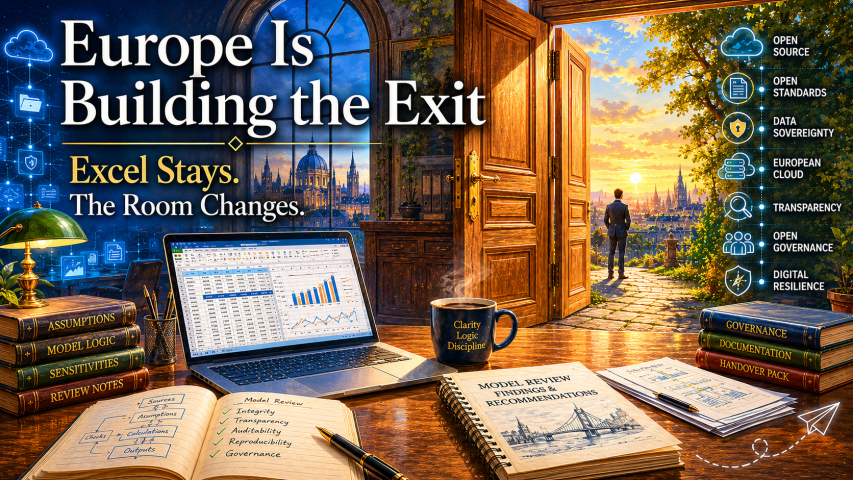
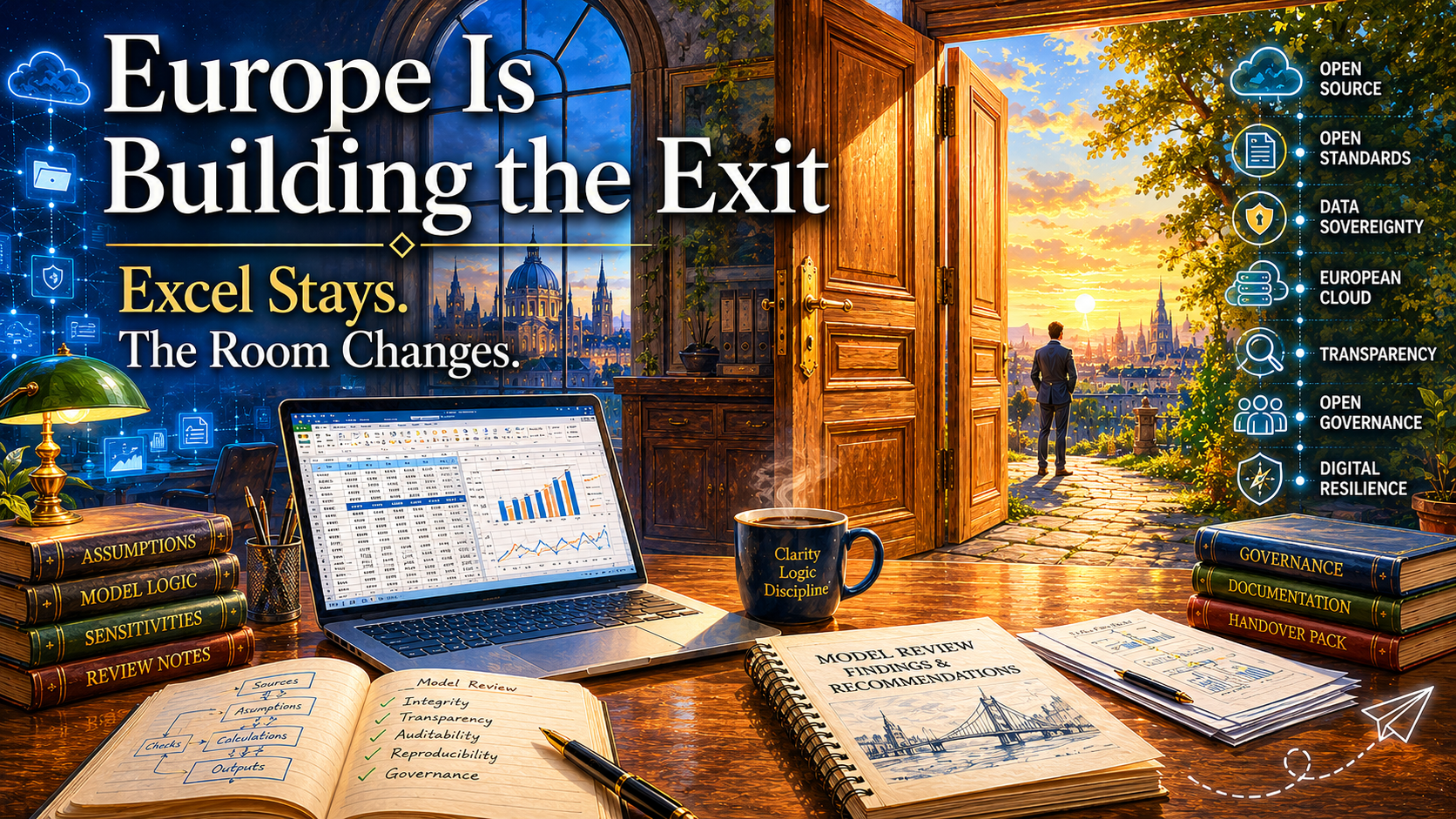
At some point, Microsoft stopped being a toolbox. It became the room.
And once something becomes the room, leaving it no longer feels like a purchasing decision. It feels like architecture. It feels like plumbing. It feels like asking whether the office building itself might prefer to be dismantled over the weekend, which, as a project plan, has traditionally received mixed feedback from management.
But Europe is starting to ask the question anyway. Not loudly. Not always elegantly. Not without politics, friction, technical debt, licensing drama and the occasional open-source family argument around the dinner table. But seriously.
Europe is building the exit.
Not one exit, of course. Europe rarely builds one clean door when it can build a corridor, a steering committee, three pilot projects and a procurement framework. But the direction matters.
This is not the exit from Microsoft tomorrow morning. Not the heroic, slightly theatrical moment where a public administration uninstalls Excel at dawn while a brass band plays Beethoven. The real story is more interesting than that. Europe is beginning to ask what it would actually take to not be fully dependent on one non-European digital workplace ecosystem.
And that question is much more dangerous to Microsoft than any single office suite. Because Microsoft’s strongest product may not be Word. It may not be PowerPoint. It may not even be Excel, although I say this with the appropriate respect and a slight tremble in my modeller’s hand.
Microsoft’s strongest product is inevitability.
And once people begin to question inevitability, the room changes.
Europe is no longer just complaining
For years, Europe spoke about digital sovereignty in the usual way: policy papers, conferences, panels and carefully arranged sentences about resilience, data, values, innovation and strategic autonomy. All important, of course. But often the discussion stayed safely abstract. Digital sovereignty sounded like something that happened somewhere between a Brussels working group and a procurement slide deck.
Then the conversation started to become practical. Schleswig-Holstein began moving public-sector workplaces away from Microsoft Office and towards open-source alternatives. The story there is not simple, and that is exactly why it is useful. The state has reported significant progress in moving office workplaces to LibreOffice, while still acknowledging that some parts of the administration remain dependent on Microsoft Office because of links to specialist systems. In other words: migration is real, but so is gravity.
Denmark has been testing open-source alternatives in parts of its public administration. The European Data Protection Supervisor has piloted open-source collaboration tools such as Nextcloud and Collabora. openDesk has emerged as a sovereign workplace stack for the public sector. Nextcloud, IONOS, OpenProject, XWiki, Open-Xchange, Collabora, LibreOffice and others have moved from “nice niche names for open-source people” towards “perhaps we should invite them to the meeting”.
And now there is Euro-Office.
Euro-Office is not the whole story, but it is a very visible new chapter. It is positioned as a European open-source alternative to Microsoft 365 and Google Workspace. Its first stable version is scheduled for 9 June 2026. It is backed by a coalition of European organisations, including names such as IONOS, Nextcloud, XWiki, OpenProject, Open-Xchange and Office.eu. It is designed for browser-based collaboration on documents, spreadsheets, presentations and PDFs, with support for familiar formats such as DOCX, XLSX and PPTX as well as open formats such as ODT, ODS and ODP.
That already makes it worth watching. But the really interesting part is not that Europe is launching another office tool. The interesting part is what kind of question Euro-Office represents.
The news is not that Microsoft has been replaced. It has not. The news is that replacement is no longer only a fantasy topic for conference panels. It is becoming an engineering, procurement, governance and migration question. And that is a very different thing.
This is not an OpenOffice nostalgia project
Before we go any further, we need to remove a common misunderstanding. Euro-Office is not OpenOffice. It is also not simply LibreOffice with an EU flag and a slightly more determined expression.
Euro-Office is based on a fork of ONLYOFFICE. That detail matters.
A fork, in open-source terms, means taking an existing open-source codebase and developing it independently under the relevant licence conditions. It is not a purchase. It is not a partnership. It is not merely changing the logo and hoping nobody notices, although history suggests that humans do enjoy logos rather more than is healthy.
A fork is the open-source emergency exit with a Git history.
And in this case, the fork is the story.
ONLYOFFICE is an attractive basis for a simple reason: it is already closer to a modern browser-based, Microsoft-style collaborative office experience than many older desktop-first office suites. It is web-oriented. It is collaborative. It has a user experience that feels familiar to people who have spent decades inside Microsoft Office. It focuses strongly on Microsoft file format compatibility, which is not a small matter when the world is full of DOCX, XLSX and PPTX files that arrive by email with the confidence of small invading armies.
So the decision to start from ONLYOFFICE is technically understandable. Europe does not merely need a replacement for Word sitting alone on a desktop. It needs workplace components that can live inside modern collaboration environments: file platforms, wikis, project systems, cloud storage, identity layers, shared editing and governed workflows.
The competitor is not only Microsoft Office. The competitor is Microsoft 365 as an ecosystem. And if you want to build an alternative to an ecosystem, you do not start by polishing a typewriter.
The uncomfortable ONLYOFFICE twist
Here is where the story becomes properly interesting. ONLYOFFICE is technically attractive, but it is also governance-sensitive.
There have been public concerns and controversies around ONLYOFFICE’s history, perceived Russian links, development processes, licensing, transparency and control. ONLYOFFICE presents its own position and legal structure differently, and it has publicly challenged the Euro-Office project over alleged licence violations. Euro-Office and Nextcloud, in turn, argue that their fork is compliant with the AGPLv3 and that some branding and trademark-related conditions in the ONLYOFFICE codebase raised problems of their own.
This is not a side drama. This is the heart of the matter.
Because digital sovereignty does not begin with a flag.
It begins with build instructions.
It begins with the boring questions. Who controls the code? Who can build it? Who understands the dependencies? Who signs the releases? Who handles security issues? Who accepts contributions? Who decides the roadmap? Who finances maintenance? Who is still there in five years, when the launch excitement has gone home and the software is quietly expected to work on a rainy Tuesday in November?
That is where sovereignty becomes real. It is very easy to say “European alternative”. It is much harder to create something that is open enough to inspect, funded enough to maintain, governed enough to trust, boring enough to procure and good enough to use every day.
Euro-Office is not automatically sovereign because it has a European name. The project has to prove sovereignty through code quality, governance, security, transparency, funding, support and adoption.
That is not a criticism. That is the job.
The first release is not the story. Maintenance is.
The first stable Euro-Office release matters. Of course it does. But the release is not the finish line. It is the first serious checkpoint.
Euro-Office appears to have more substance than a press release. There are serious partners. IONOS brings infrastructure, market reach, cloud credibility and a route into enterprise and public-sector environments. Nextcloud gives Euro-Office a place to live: files, sharing, permissions, collaboration, user workflows and a real working environment where an office editor can become useful. Other partners such as XWiki, OpenProject, Open-Xchange and Office.eu add further pieces of a wider European workplace stack.
There are also signs of actual development work: code clean-up, better documentation, automated tests, security updates, translated comments and efforts to make the code easier to build and contribute to. That matters, because open source is not merely the ability to see the code. It is the ability to understand it, build it, test it, improve it and take responsibility for it.
Still, we should not confuse promising signs with proof. The project shows visible partner substance, but I have not found a clearly published long-term funding amount or multi-year financial plan. There are no broadly visible public-sector reference migrations to Euro-Office yet. That is not surprising before the first stable release, but it matters.
At the time of writing, I have not found publicly visible independent security audits, SBOMs or reproducible-build assurances for Euro-Office. For a project aimed at public administrations and regulated industries, that should become part of the next credibility layer. There is public discussion of code review, security updates and clean-up, which is a good start. But audit-grade transparency is the next step.
Euro-Office is serious enough to watch.
It is not yet proven enough to trust blindly.
And perhaps that is the most honest place for the article to sit. Because sovereignty is not the fork. The fork is where the work starts.
The launch gets the headline. The maintenance gets the bill. And the bill is where sovereignty usually stops being a speech and starts becoming a spreadsheet.
Microsoft has heard the word sovereignty too
It would be a mistake to imagine Microsoft sitting somewhere in Redmond, gently surprised that Europeans have discovered the word “sovereignty”. Microsoft is not asleep. Microsoft has heard the word very clearly.
Microsoft is not ignoring this debate. Microsoft is productising its answer to it.
That is why Microsoft now speaks so strongly about European digital commitments, EU data boundaries, sovereign cloud, local control, resilience, compliance and trust. It has announced European digital commitments, completed its EU Data Boundary, expanded commitments around AI-powered productivity services such as Copilot, and launched broader sovereign cloud offerings for European organisations.
This is not accidental language. Microsoft understands the new European buying question. For years, the question was mostly: does it work? Now the question is also: where is the data? Which law applies? Who can access it? Can we control the keys? What happens in a geopolitical crisis? Can we keep operating? Can we audit the system? Can we leave?
Microsoft’s answer to digital sovereignty is, essentially: stay with us, but with more controls. The open-source answer is different: build something you can understand, inspect, modify and leave with.
Both answers matter. Both have strengths. Both deserve scrutiny. And that is why this is not a simple story of good Europe versus bad Microsoft, or brave open source versus dark proprietary empires. Real life, tragically, continues to resist becoming a LinkedIn carousel.
Microsoft provides excellent tools. Many organisations depend on them for good reasons. Microsoft 365 is powerful, integrated and productive. Excel, in particular, remains one of the most important business tools ever created. I am not writing this from a cave, carving formulas into a stone tablet while waiting for European cloud purity to descend from the Alps.
But good tools should earn trust continuously. They should not inherit it forever because leaving became too hard.
Euro-Office will not replace Microsoft 365 by next Tuesday
Let us stay calm for a moment, which is always a dangerous suggestion in technology discussions. Euro-Office is not going to replace the entire Microsoft 365 universe overnight.
If you expect it to replace Word, Excel, PowerPoint, Teams, SharePoint, OneDrive, Outlook, Entra, Power Platform, Copilot, all your templates, all your add-ins, all your training materials, all your admin processes and your finance team’s sacred colour-coding habits by next Tuesday, you will be disappointed. Possibly by Wednesday as well.
But that is the wrong test.
The real question is not whether Euro-Office can replace everything. The real question is whether Euro-Office and the wider European open-source workplace ecosystem can replace enough ordinary office work to make Microsoft feel less inevitable.
Can many public-sector reports be written outside Microsoft Office? Can drafts be collaborated on outside Google Docs? Can internal documentation live in European platforms? Can file storage move to Nextcloud? Can project work move to OpenProject? Can knowledge management live in XWiki? Can email and collaboration move to European providers? Can open formats become more than a polite afterthought?
If the answer to enough of these questions becomes yes, the market changes. Not because Microsoft disappears, but because Microsoft has to compete against an exit plan. And that is a very different kind of competition.
Why should a financial modeller care?
At this point, you may reasonably ask why a financial modeller is getting involved in an office-suite drama involving GitHub, licensing, sovereignty, geopolitics and rather more governance than anyone requested before breakfast.
Fair question. I asked myself the same thing, somewhere between my second coffee and my first existential spreadsheet.
This is why the topic followed me home. I came for the office-suite drama and found a model-review problem wearing a European hat.
The answer is simple: a financial model is usually built in Excel, but it lives in an ecosystem.
The model itself may sit in an XLSX or XLSM file. But around it there is an entire professional universe: assumption books, source evidence, documentation, review notes, version logs, findings registers, handover packs, board reports, management presentations, email trails, Teams chats, SharePoint folders, permissions, approvals, audit trails and the quiet hope that someone remembered which version was final-final-really-final.
A model is not just a file. It is a governed object.
And if we take model governance seriously, we should also take the governance of the digital environment around the model seriously. Because the questions are strangely similar. Can we understand it? Can we review it? Can we audit it? Can we maintain it? Can we explain it? Can we transfer it? Can we leave it without breaking the organisation?
Good financial modelling and good digital sovereignty have more in common than one might think.
Both are allergic to black boxes.
Excel stays. The ecosystem may move.
Let me be very clear before anyone starts lovingly polishing their favourite spreadsheet keyboard shortcut in self-defence. Excel is not leaving financial modelling any time soon.
For serious financial modelling, Excel remains incredibly hard to replace. Not because alternative spreadsheets are useless. They are not. But because Excel is more than a spreadsheet application in our profession. It is a modelling language, a review surface, a client expectation, a banking standard, a training environment, an add-in platform, a formatting culture and a shortcut universe. It is a place where Power Query, VBA, dynamic arrays, data tables, named ranges, model maps, audit sheets, error checks and the occasional circularity all live together in a slightly tense but functional family arrangement.
Complex project finance models, valuation models, transaction models and infrastructure models will not move to Euro-Office soon. That is not the point.
Excel may remain the engine.
But Europe may begin rebuilding the garage around it.
The financial model may still be in Excel. But the assumption book could live elsewhere. The review report could be written elsewhere. The findings register could be managed elsewhere. The handover pack could be stored elsewhere. The project workflow could be governed elsewhere. The knowledge base could sit elsewhere. The client collaboration environment could be outside Microsoft 365.
This is where the change may begin. Not in the heart of the model, but at the edges. And in professional work, edges matter. Because the edges are where files are shared, assumptions are approved, comments are lost, versions are confused, risks are documented, responsibilities are assigned and memories quietly leave the organisation when someone changes jobs.
If Europe builds credible alternatives around the model lifecycle, financial modellers will need to understand them. Not because Excel is dead, but because Excel may no longer automatically own everything around the model.
The model-review lesson for software sovereignty
There is a lovely, slightly uncomfortable parallel here. Euro-Office starts from an existing codebase. It inherits something that works, at least in many ways. But it also inherits history, assumptions, technical debt, documentation gaps, dependencies, governance questions and trust issues.
That is exactly what happens when a modeller inherits an existing financial model.
The file opens. The formulas calculate. The formatting looks broadly professional. Someone says, “It has been used before.” And somewhere in the distance, a reviewer quietly reaches for coffee.
Because opening is not understanding. Calculating is not controlling. A copied model without review is not automatically reliable. It may work. It may even produce the right answer for the wrong reasons, which is the most financially dangerous kind of politeness.
Euro-Office inherits a codebase. Financial modellers inherit workbooks. In both cases, the dangerous sentence is the same: “It has been used before.”
The responsible thing to do is to review it: understand the logic, map the dependencies, check the assumptions, clean the structure, document the process, remove avoidable risks, clarify ownership, make it maintainable, make it transferable and make it reviewable.
That is also the real test for Euro-Office.
A fork without governance is like a copied financial model without a review: it may open, it may calculate, but you should not bet the organisation on it yet.
That is not an argument against Euro-Office. It is an argument for taking it seriously. If Europe wants sovereign software, it must do the boring professional work that makes software worth trusting. Not only launch it. Maintain it.
This is not anti-Microsoft. It is pro-optionality.
The temptation in a topic like this is to turn it into a football match: Microsoft versus Europe, proprietary versus open source, America versus digital sovereignty, Excel versus whatever brave spreadsheet is trying to get invited to lunch.
That would be emotionally satisfying and intellectually lazy.
This is not an anti-Microsoft argument. Microsoft has built extraordinary tools. Many organisations will continue using them, and many will be right to do so. Excel remains central to financial modelling. Microsoft 365 remains a powerful, productive, deeply integrated workplace platform. Copilot and AI-assisted workflows will become increasingly important. Pretending otherwise would not be independence. It would be theatre.
But it is also not healthy for any organisation, sector or continent to confuse convenience with strategy. Vendor lock-in is not a moral failure. It is often the result of perfectly rational decisions made one integration at a time. But at some point, rational decisions compound into structural dependency. And then governance enters the room.
The question becomes: can we choose differently if we need to?
That is the real value of Euro-Office, openDesk, Nextcloud, LibreOffice, Collabora, OpenProject and the wider European open-source workplace movement. Not that they instantly replace Microsoft, but that they make the question of replacement practical again.
They create optionality.
And optionality has value.
Any financial modeller should know that.
The room has a door
Euro-Office may not become the suite that replaces Microsoft Office. Not soon. Maybe not ever in the dramatic way some headlines would enjoy. But it may become something more interesting: a visible test case for whether Europe can turn digital sovereignty from a slogan into operational capability.
Can Europe build tools, govern them, fund them, secure them, audit them, support them and make them usable enough that real people with real deadlines and real templates stop asking for the old system back by lunchtime?
That is the test. And it will not be passed on launch day. It will be passed, or failed, in maintenance, support tickets, migration projects, procurement requirements, training sessions, security audits, public-sector pilots, boring release notes, the patience of users and the ability to keep going after the excitement fades.
That is where sovereignty lives. Not in the announcement. In the upkeep.
As financial modellers, we know this feeling. A model can look elegant on the surface and still hide dangerous dependencies underneath. The same can be true of a digital workplace.
A model you cannot review is a risk.
A digital workplace you cannot exit is also a risk.
Microsoft is not leaving the room. Excel is certainly not leaving my desk. But Europe has started looking for the door.
And once you have seen the door, the room never feels quite the same again.
Sources
Euro-Office release, partners, scope and integration plans: Nextcloud announcement and related reporting on the 9 June 2026 release.
Euro-Office codebase and fork: Euro-Office GitHub project information.
ONLYOFFICE / Euro-Office licensing dispute: ONLYOFFICE public statement and Nextcloud’s AGPLv3 response.
European public-sector open-source context: Schleswig-Holstein open-source migration, Denmark’s open-source pilot, EDPS pilot with Nextcloud and Collabora.
Microsoft sovereignty strategy: Microsoft European Digital Commitments, EU Data Boundary, Sovereign Cloud and Microsoft 365 Local announcements.
