
AI & Professional Judgement
The Paradox of Purpose
About human nature in the age of artificial intelligence
There are moments in history when technology does not simply advance – it holds up a mirror. Sometimes a flattering mirror, sometimes a funhouse one. And occasionally, as with artificial intelligence, a mirror so accurate that people respond much like a cat spotting its own reflection: tentative, puzzled, and not entirely convinced this new creature can be trusted.
In theory, we now live among tools capable of extraordinary linguistic finesse. In practice, we treat these same tools like Victorian servants: “Yes, you may clean the silver and polish the floors, but please don’t speak unless spoken to.”
It is the oddest contradiction of modern life.
We built machines that are exceptionally good with language – summarising, drafting, explaining, translating, structuring – yet the moment they actually do these things, large parts of society narrow their eyes suspiciously, as if the machine has crossed a boundary no one explicitly drew but everyone somehow feels.
And then, almost comically, we turn around and ask the very same models to audit our spreadsheets, find our missing brackets, size our debt facilities, and suggest improvements for our cash flow waterfalls.
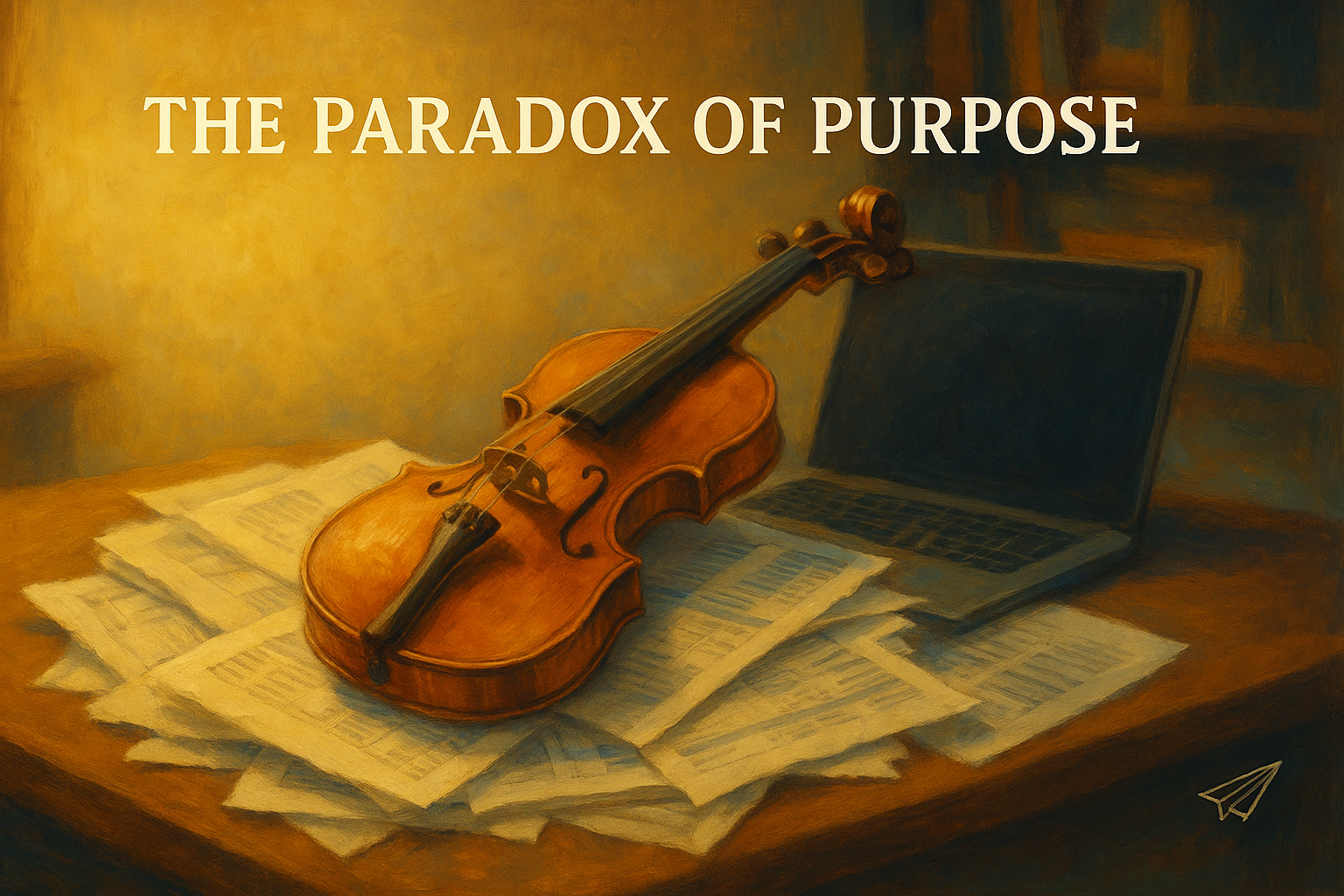
It’s a bit like commissioning a Stradivarius violin and promptly using it as a shoehorn.
But before we mock ourselves too harshly, it’s worth unpacking the psychology behind this strange behaviour. Because, as several researchers have pointed out, it reveals more about us than about the machines.
I. When Writing Stops Being a Skill and Starts Being a Territory
One of the more enduring human beliefs is that language is deeply personal. Cognitive scientists like Pinker (2011) and Tomasello (2019) have written extensively about this: humans treat language not merely as a tool, but as part of their identity. It carries culture, emotion, memory, humour, and that peculiar sparkle we call personality.
So when a machine writes exceptionally well, we do not respond with: “How marvellous!” Instead we think: “How dare it.”
The anthropologist Ernest Becker might have called this a soft threat to the human ego – the fear of being overshadowed in an area we quietly regard as “our thing.”
And so, even when an AI produces a perfectly competent text, we sometimes reject it on principle. Not because it is inaccurate, but because it feels like letting the dishwasher compose the dinner speeches.
II. Meanwhile, in Spreadsheet-Land…
The irony is that the same people who frown at AI-written paragraphs show absolutely no hesitation in asking AI to do things far beyond its intended linguistic domain.
Take spreadsheets, for example.
Fix my formulas. Find the broken links. Explain why the balance sheet doesn’t balance. Apply the correct depreciation logic. Clean those 8,000 mismatched rows. And while you’re at it, can you also interpret this tax schedule that was last updated during the Bronze Age?
This acceptance aligns neatly with what behavioural economists call effort avoidance (Kahneman, 2011). Humans happily delegate cognitively draining or tedious tasks – particularly those that feel technical rather than expressive.
No one feels spiritually diminished when a machine trims an unwieldy Excel formula.
But let the same machine write a friendly team update about next month’s planning meeting, and suddenly everyone develops strong views about authenticity.
III. The Great Misconception: What Is Easy vs. What Only Feels Easy
There is a long-standing cultural intuition – incorrect but persistent – that structured tasks should be easier for machines than creative ones. This is understandable, but outdated.
In truth, natural language is one of the most structured systems we possess. As the linguist George Lakoff famously noted, “Every sentence carries an implicit mathematical structure – syntax is logic wearing a warm coat.”
Financial models, meanwhile, are rarely as clean as they look. Anyone who has ever opened a vendor model knows the experience sits somewhere between archaeology and urban exploration.
Yet people assume AI is naturally suited for such work.
Why?
Because modelling looks analytical from the outside.
This mirrors a psychological phenomenon documented by Rozenblit & Keil (2002): the “illusion of explanatory depth.” Humans believe they understand complex systems – until asked to explain them precisely. We mistake familiarity for competence.
Thus, many assume AI can do modelling simply because modelling has numbers in it.
Language, on the other hand, looks deceptively simple. Everyone writes. Everyone talks.
And precisely because everyone does it, people feel strangely protective of it.
IV. Identity, Pride, and the Fragile Nature of Human Creativity
Here we arrive at the bittersweet core.
Psychologists have observed that people judge creative domains as extensions of the self. Keith Sawyer (2006) describes creativity as “a performance of individuality.” When a machine performs well in such a domain, the reaction is not admiration but discomfort.
We are not threatened by AI fixing a cash sweep. We are threatened by AI writing a compelling argument.
We worry that if a machine can write beautifully, our own writing becomes… negotiable.
This is irrational, of course. But humans are not primarily rational creatures – we rationalise our feelings after the fact.
And so we accept AI in tasks that feel beneath us, while resisting it in tasks that feel like us.
V. Why Effortlessness Feels Unfair
There is a charming human belief that meaningful work should be difficult. That good writing requires at least two cups of coffee, a tortured sigh, a long stare out of the window, and perhaps a brief crisis of faith.
When AI produces a polished paragraph in half a second, we find it suspicious. As if the ease itself invalidates the quality.
This is tied to what psychologists call effort heuristic bias (Kruger, Wirtz & Van Boven, 2004): the tendency to value outcomes more when they appear difficult to produce.
If Shakespeare had watched a language model rewrite one of his sonnets in another style in one second, he might have needed to sit down.
VI. Misusing Great Tools Is a Human Tradition
Humans have always used tools for the wrong purpose first.
The internet was created to share scientific files; we used it for cat videos. Mobile phones were invented for calls; we barely use them for that anymore. GPS was for military navigation; now it guides us to the nearest bakery.
So perhaps it is perfectly on brand that we now use a sophisticated linguistic model to… format spreadsheets.
There is comfort in this. Misappropriation is, in some sense, the sincerest form of acceptance.
But it is also a reminder that we often turn away from the parts of a tool that challenge us emotionally.
VII. The Ironic Paradox: AI Is Distrusted Where It Excels
This is the paradox that sparked this whole reflection:
We distrust AI most in the domain it was explicitly designed for – language. And we trust it most in domains for which it was not designed at all – technical modelling.
It’s a wonderfully human contradiction, the kind that makes you smile and sigh at the same time.
We are willing to hand over a complex debt schedule to a linguistic model but would hesitate to let it write a public announcement for next Monday’s team meeting.
As peculiar as this is, it fits squarely within documented behavioural patterns: humans are consistently motivated less by efficiency and more by identity protection (Akerlof & Kranton, 2010).
We don’t resist AI because it is too weak. We resist it because it is sometimes too strong in areas that feel personal.
VIII. A Kinder Way Forward
Perhaps the healthiest way to approach AI is not to fear its strengths nor romanticise its weaknesses.
Perhaps the question should be:
Does this help us think, create, decide, build, or understand better?
If yes, why not welcome it?
AI has no pride to injure and no ambitions to indulge. It is not trying to replace us. It is simply trying to be useful.
The challenge, then, is not technological but emotional: can we allow ourselves to be supported in the very areas we secretly believe define who we are?
Humility, after all, has never been humanity’s strongest suit. But humour often is – and humour may be precisely what we need to navigate this new chapter.
IX. A Closing Thought
If future generations look back on this era, they will probably shake their heads affectionately and say:
“Remember when early AI was extraordinarily good with language, and humans said, ‘No thank you, please fix my Excel sheet instead’? Remember when we trusted it with debt sizing but not with thank-you notes? Remember when we spent years arguing whether machine-written text was morally acceptable, as if the coffee machine might one day steal our personalities?”
And then they’ll laugh, because distance tends to turn our anxieties into comedy.
Perhaps, when the dust settles, we will finally let the piano play the music it was built for, instead of making it hold our heavy books.
And perhaps we will sit nearby, listening with relief rather than fear, realising that our humanity was never threatened – it was simply evolving.
Sources
- Kahneman, Daniel (2011). Thinking, Fast and Slow.
- Pinker, Steven (2011). The Better Angels of Our Nature.
- Tomasello, Michael (2019). Becoming Human.
- Rozenblit, L. & Keil, F. (2002). “The Misunderstood Limits of Folk Science.”
- Lakoff, George (1987). Women, Fire and Dangerous Things.
- Keil, F. (2003). Cognitive Science and Explanation.
- Sawyer, Keith (2006). Explaining Creativity.
- Kruger, J., Wirtz, D., & Van Boven, L. (2004). “The Effort Heuristic.”
- Akerlof, George A. & Kranton, Rachel (2010). Identity Economics.
