
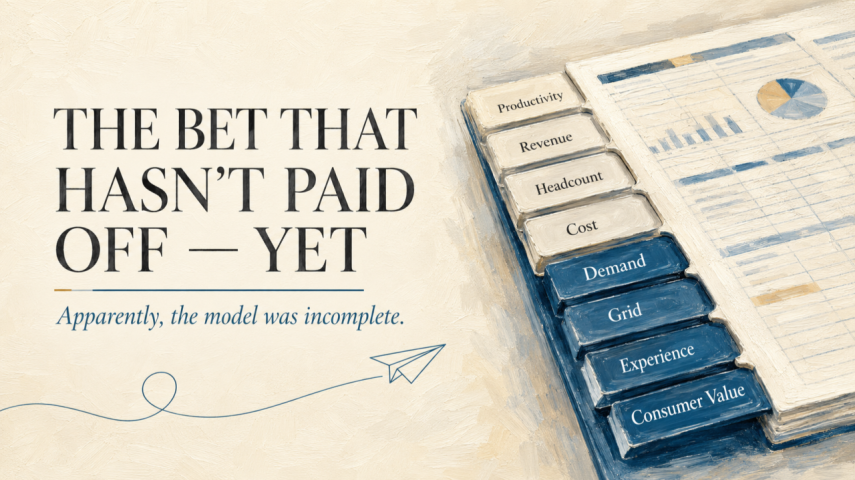
The Bet That Hasn’t Paid Off — Yet
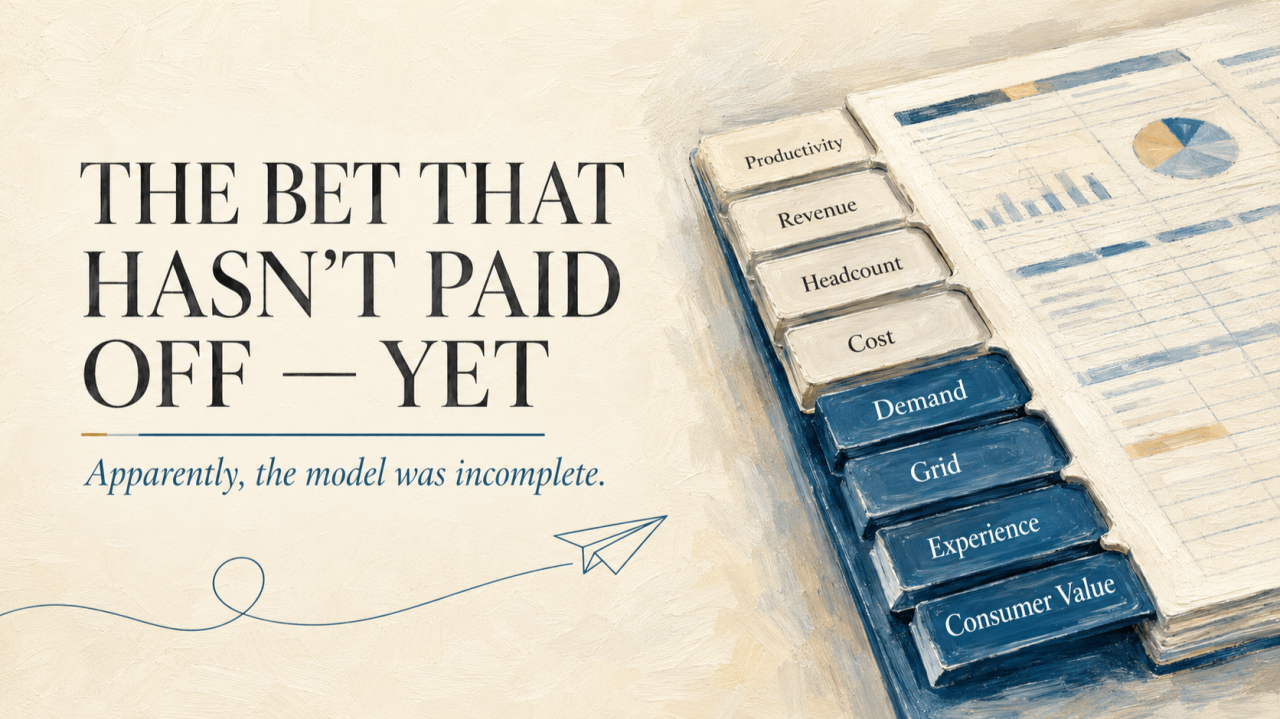
Except that it has. Just not where I thought it would.
I had already decided what this article was going to say, which is not generally considered best practice in research but does save an enormous amount of time.
The argument seemed obvious. We have spent an almost indecent amount of money on artificial intelligence. Companies have promised lower costs, higher revenues and armies of digital workers who do not sleep, complain or ask whether they may work from home on Friday. Governments have promised productivity, growth, jobs and, if you stay for the more enthusiastic part of the presentation, perhaps even salvation from public debt.
The charts were magnificent. They usually are.
And yet the great AI productivity miracle seemed to have one curious characteristic: it was always about to happen.
So I had my article. I even had the title.
The Bet That Hasn't Paid Off – Yet.
Then I made the tactical error of checking the evidence.
It turns out AI works.
Irritatingly well, in some cases.
The article I was going to write
One of the better studies I found followed 4,867 software developers in three randomised field experiments at Microsoft, Accenture and another Fortune 100 company. Give them an AI coding assistant and they completed about 26% more tasks.[1]
That is not a focus group in which twelve managers reported feeling “more empowered”. It is a proper field experiment, and 26% is rather a lot when your entire article is quietly hoping the number will be closer to zero.
There are similar findings in customer support, writing and other knowledge work. The numbers differ, the circumstances differ, the limitations certainly differ, but the direction has become hard to dismiss: AI can make people meaningfully more productive at individual tasks.
So my original thesis was already looking slightly unwell.
The better question was not whether AI could save time.
It was what happened to the time afterwards.
And that led to perhaps the most useful paper in this entire little adventure. Researchers followed more than 100,000 software developers and tracked what happened as successive generations of AI coding tools became more capable.[2]
The numbers start off beautifully. Autocomplete increased commits by around 40%. Interactive coding agents pushed the cumulative gain to roughly 140%. Autonomous agents took it to around 180%.
Wonderful. We shall all be home shortly.
Except the researchers did something rather inconsiderate.
They kept following the work after the impressive bit.
By the time all that extra coding became projects, the gain was closer to 50%. By the time it became software actually released to users, it was around 30%.
Thirty per cent is still excellent. The effect did not vanish.
But an awful lot happened to it on the journey.
There was review. Integration. Testing. Approval. Deployment. Human judgement. And, finally, the most stubborn bottleneck in capitalism: somebody has to want the thing you have produced.
Across major app marketplaces, more software was being released, but total usage did not increase with it.[2]
Apparently the ability to produce more apps does not add hours to somebody else's day.
The researchers describe a weak-link problem. Improve one stage dramatically and the constraint simply moves somewhere else.
AI doesn't eliminate bottlenecks. It moves them.
That started to feel familiar.
A first draft can now be produced almost instantly. Reviewing a bad first draft cannot.
An analysis can be generated in seconds. Working out whether it is nonsense remains irritatingly analogue.
A presentation can now be produced during the meeting in which somebody asks for the presentation. This is technologically impressive and may, on balance, have been a mistake.
And if one employee can produce ten reports instead of five, the company has not necessarily doubled productivity.
Somebody now has ten reports to read.
We have become extraordinarily good at measuring the speed of generation. We are rather less good at measuring the queue forming behind it.
Even the great AI-adoption numbers start looking different once you look at what “adoption” actually means. Recent ECB work found that more than 70% of euro-area firms use AI in some form, while only around 7% use it intensively.[3]
That is quite a gap.
Buying access is easy. Becoming a different company because of it is not.
The latter means changing workflows, systems, controls, responsibilities, incentives and the mildly awkward question of what exactly happens to the three hours the machine just saved.
Perhaps we confused adoption with transformation.
At this point the original article was in some distress.
Then the business case itself started looking suspicious.
There is something wonderfully human about how companies first approached AI. We created machines capable of writing software, translating languages, analysing contracts, discussing Dostoevsky and producing images of cats dressed as Napoleon.
And within roughly forty-five minutes somebody in a steering committee asked whether they could remove two FTEs from Accounts Payable.
This may tell us less about artificial intelligence than about us.
Most early corporate AI cases were built around efficiency: do the same thing faster, automate tasks, reduce labour, lower cost, improve margins.
Perfectly sensible.
But the emerging evidence increasingly suggests that the stronger returns may come from somewhere else.
A 2026 study of nearly 750 corporate executives found positive AI-related productivity gains, with particularly strong links to innovation and demand-oriented uses – better products, better services, better ways of reaching customers.[4]
PwC, using a very different survey of 1,217 companies, found that the top 20% captured 74% of the AI-driven value measured in the study. The stronger performers were not merely automating more enthusiastically. They were more likely to use AI for growth, new offerings, new markets and business-model reinvention.[5]
It is a PwC survey, not experimental economics, so I would not build a cathedral around it. But it points in the same direction as the corporate-executive evidence.
And that direction is interesting.
Perhaps we made an efficiency bet when we should have been making a growth and innovation bet.
Suppose AI saves an analyst four hours a week.
Good.
Now what?
If those four hours become another internal meeting, there has been a technological triumph of uncertain economic significance.
If the company genuinely removes four hours of cost, there is a margin benefit.
If the analyst uses them to improve a product customers will actually buy, there is a revenue benefit.
And if AI makes it economically possible to build something that simply could not have been built before, then we have moved into a different kind of value creation entirely.
The original AI story jumped very quickly from “this task is faster” to “therefore the company is more valuable”.
There is an awful lot of company between those two statements.
And this was where my original argument finally gave up.
The bet had not simply failed. Some companies were clearly getting paid. AI was clearly producing productivity. The returns were simply uneven, and a great deal depended on what companies were actually trying to do with the technology.
So the more interesting possibility became:
The bet wasn't necessarily wrong. The business case was.
The macroeconomy does not settle the argument either. US labour productivity has been doing reasonably well. It was 2.2% higher in the second quarter of 2026 than a year earlier, and productivity growth since late 2019 has averaged about 2.1% annually.[6]
That is good.
It is not exactly an economy screaming, “Good Lord, the robots.”
We do not yet know how much of the improvement is AI. Assuming the answer is zero now seems difficult to defend. Claiming that we can already see the full AI productivity revolution seems equally adventurous.
So we are somewhere in the middle.
Annoying, I know.
The missing schedules
Then I realised that I had been treating “payoff” as though it meant something conveniently visible in a company's profit and loss account or a national productivity statistic.
It doesn't.
Take consumers. Stanford researchers recently asked US users how much they would need to be paid to give up generative AI for a month. Their estimate for March 2026 implied roughly $172 billion of annual US consumer surplus.[7]
That value is not the AI provider's revenue. It may barely appear in GDP. But if somebody receives a service for $20 and values it at $100, the other $80 did not vanish merely because there was no invoice.
The same applies to accessibility, translation, education, scientific research, lower-cost expertise and the things we have not invented yet.
So my original calculation had probably understated the upside.
I felt much better about this for approximately eleven minutes.
Then I looked at the other side.
We have a slightly unfortunate habit of calling all of this “the cloud”, which makes it sound as though AI lives peacefully somewhere above Belgium.
It does not.
It lives in enormous buildings full of very expensive chips attached to very real electricity grids, cooling systems, water supplies and financing structures.
The International Energy Agency expects global data-centre electricity consumption to reach roughly 950 TWh by 2030, with AI-related computing one of the main drivers of that growth.[8]
That figure is for data centres generally, not AI alone, and the distinction matters.
Still, for something apparently floating in the cloud, this technology is becoming remarkably physical.
And this is where the economic model expands again.
Some benefits go to consumers who pay almost nothing for them. Some infrastructure costs may fall partly on people who receive very little benefit. AI increases electricity demand but may also help optimise electricity grids. It consumes resources in one place and may reduce waste somewhere else.
There is no intellectually serious shortcut here. You have to model both sides.
The same goes for cybercrime, fraud, intellectual property and information overload.
We have, after all, solved one of civilisation's oldest constraints: the cost of producing mediocre content.
I am not entirely sure we had identified that as the bottleneck.
Then there is the human problem.
The evidence does not currently show an economy-wide AI jobs apocalypse. That particular horseman appears to have missed the train.
But there are early warning signs for younger workers in highly AI-exposed occupations. Stanford's latest payroll work finds a sizeable relative employment gap for 22- to 25-year-olds in those jobs, although the researchers themselves are careful not to claim that AI cleanly caused the whole thing.[9]
What interested me more was the pattern underneath.
Work built around codified knowledge – formalised, documented, teachable knowledge – appears more exposed.
Work relying heavily on tacit knowledge – judgement acquired through practice and experience – appears more resilient.[9]
Which creates an awkward little circularity.
Where do we get human judgement?
Usually from experience.
And where do we get experience?
Traditionally, by letting inexperienced people do some work.
Ah.
“Keep a human in the loop” only works if somebody remembered to train the human first.
This is not a plea to preserve pointless junior work because suffering builds character. Some suffering merely builds PowerPoint skills.
But the training pipeline is part of the system too. If we automate the work through which young professionals used to become experienced professionals, we may eventually find ourselves wondering where all the experienced professionals have gone.
And then, because apparently the model had not acquired enough tabs, there was government debt.
CBO already assumes that wider diffusion of generative AI will add around 0.1 percentage point a year to US total factor productivity growth over the next decade.[10]
Even with that benefit, US debt held by the public is projected to reach 120% of GDP by 2036.
Under a much stronger growth scenario – not an AI-only scenario – that improves to roughly 109%.[11]
That is meaningful. Productivity helps.
But there is a wonderfully model-like sting in the tail. Stronger productivity raises returns on capital, which puts upward pressure on interest rates. In the stronger-growth scenario, higher net interest costs absorb roughly $1 trillion of the fiscal improvement.[11]
Anyone who has ever built a financial model knows this moment.
You change the assumption. One line improves beautifully. You briefly consider telling somebody.
Then you scroll down.
There it is.
Another line.
Looking at you.
AI can improve the fiscal arithmetic. It is not a substitute for fiscal policy.
Which is probably just as well. Imagine the pressure on the prompt.
So where did all of this leave my wonderfully simple article?
Not where I expected.
I began with a bet that seemed not to have paid off. That was too easy.
AI already creates real productivity. Some firms are capturing substantial value. Consumers may be receiving value that company accounts barely see. The economy may already be benefiting too, although we cannot yet separate the effect cleanly from everything else going on.
At the same time, a great deal of the spectacular task-level productivity gets absorbed as it travels through real organisations. The bottleneck moves. Deep integration is still uncommon. The benefits are uneven. And some of the costs sit outside the companies collecting the gains.
Which made me realise that my original article suffered from exactly the same problem as quite a few AI business cases.
Half the schedules were missing.
We had a productivity schedule, a headcount schedule and a software-cost schedule. Possibly a heroic sensitivity table showing adoption at 50%, 75% and 100%, because a model is not properly dressed until it has at least one sensitivity nobody believes.
What we had not necessarily modelled was the bottleneck that moved downstream.
Or the grid.
Or the junior analyst who is somehow meant to become an experienced reviewer after we automate the work juniors used to learn on.
In technical language, this is known as quite a lot of missing tabs.
And perhaps the biggest missing assumption was the simplest one.
We treated AI mainly as a way to make the old company cheaper.
The more interesting question may be:
What can we now build, sell or solve that was not economically possible before?
That is harder. It is slower. It requires changes to workflows, incentives, controls, skills and sometimes the business itself. Rather annoyingly, it also requires human judgement.
But I find that more hopeful than the easy version.
I began this research convinced that the bet had not paid off.
I was wrong.
Not completely, which is comforting. One has standards.
But enough to change the article.
AI may not be the great cost-cutting machine we first imagined.
It may turn out to be something more difficult and probably more interesting.
The machines will get better.
Perhaps our models of what they are for will too.
Evidence & sources
- Cui, Demirer, Jaffe, Musolff, Peng & Salz (2026) – The Effects of Generative AI on High-Skilled Work: Evidence from Three Field Experiments with Software Developers, Management Science. Three randomised field experiments involving 4,867 developers; estimated 26.08% increase in completed tasks, with larger gains among less experienced developers.
- Demirer, Musolff & Yang (2026) – Writing Code vs. Shipping Code: Productivity Effects Across Generations of AI Coding Tools, NBER Working Paper 35275. More than 100,000 developers; large upstream coding gains attenuating to roughly 30% more shipped releases.
- European Central Bank (2026) – Adoption and Investment in AI Across the Euro Area, Occasional Paper No. 395. More than 70% of firms report some AI use; around 7% report intensive use.
- Baslandze et al. (2026) – Artificial Intelligence, Productivity, and the Workforce: Evidence from Corporate Executives, NBER Working Paper 34984. Nearly 750 executives; positive, heterogeneous productivity effects with important innovation- and demand-oriented channels.
- PwC (2026) – AI Performance Study: Want ROI from AI? Go for Growth. 1,217 senior executives across 25 sectors; the top 20% captured 74% of measured AI-driven value. Survey evidence, not causal inference.
- US Bureau of Labor Statistics (2026) – Productivity and Costs – Second Quarter 2026. Nonfarm business labour productivity +2.2% year-on-year; 2.1% annualised growth during the current business cycle.
- Brynjolfsson, Collis, Eggers, Kazinnik & Nguyen (2026) – What is Generative AI Worth?, Stanford Digital Economy Lab. Estimated US annual consumer surplus of approximately $172 billion in March 2026.
- International Energy Agency (2026) – Key Questions on Energy and AI. Global data-centre electricity demand projected at roughly 950 TWh by 2030; AI-related computing is a major driver of incremental demand.
- Brynjolfsson, Chandar & Chen (2026) – Canaries in the Coal Mine?, Stanford Digital Economy Lab, revised August 2026. Early descriptive evidence of weaker employment among young workers in highly AI-exposed occupations, with important methodological caveats; includes analysis of codified versus tacit knowledge.
- Congressional Budget Office (2026) – The Budget and Economic Outlook: 2026 to 2036. CBO assumes wider GenAI diffusion contributes about 0.1 percentage point annually to total factor productivity growth; debt held by the public reaches 120% of GDP in 2036 in the baseline.
- Congressional Budget Office (2026) – How Budgetary and Economic Outcomes Might Differ From CBO's February 2026 Projections. Stronger-growth scenario lowers projected 2036 debt to 109% of GDP and cumulative deficits by about $1.3 trillion; higher net interest costs offset part of the improvement. This is not an AI-only scenario.