
Technology & Perspectives
Beyond the Spreadsheet
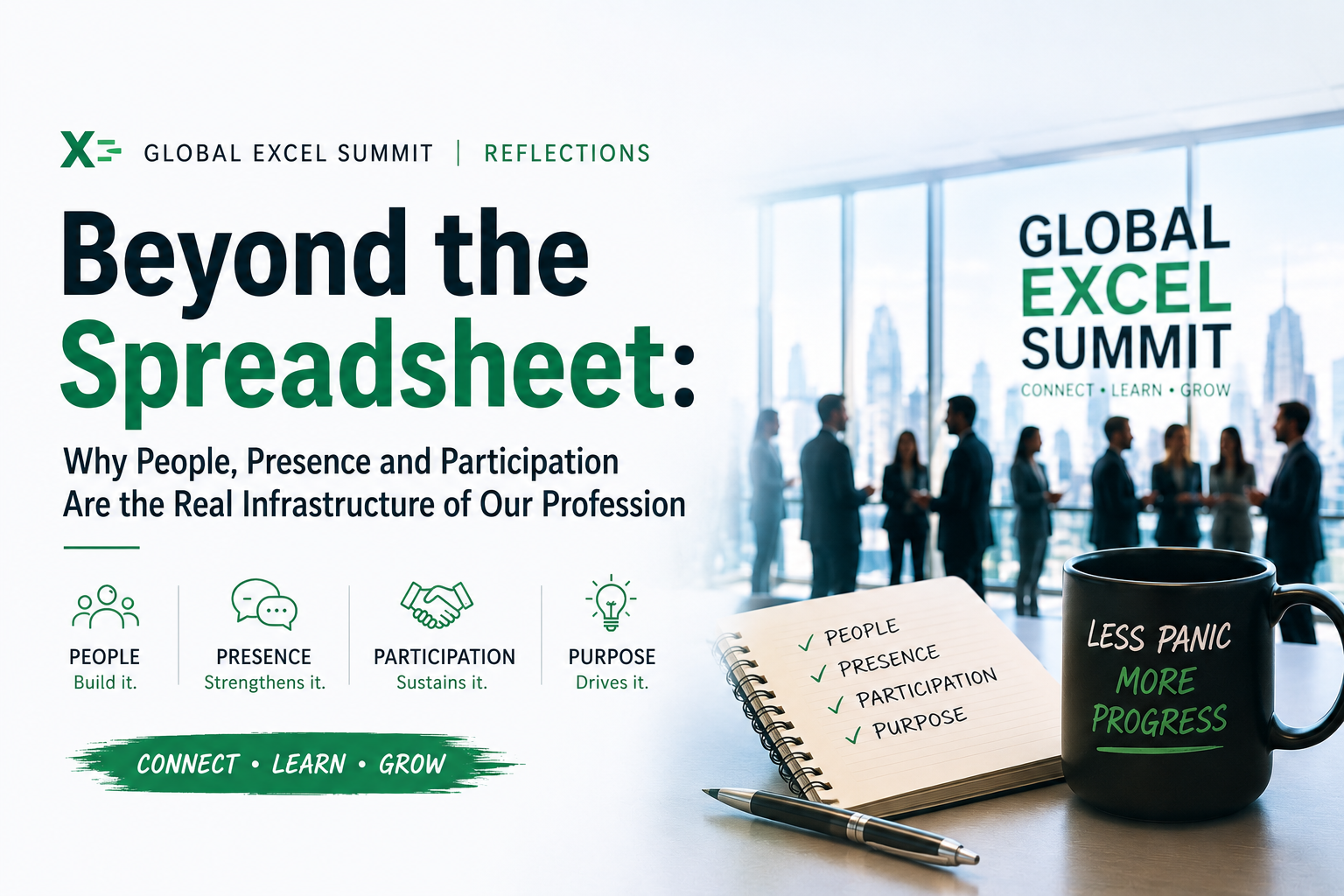
What stayed with me most after the Global Excel Summit this year was not even the technology.
Not the AI demos, the new Excel features, or the increasingly surreal moment where spreadsheets, Python, automation and machine learning now casually share the same conversations over coffee and slightly overpriced hotel pastries. Those things were all interesting, of course. Some of them genuinely impressive.
But what stayed with me was something much simpler and, in its own quiet way, probably much more important.
The people who still keep showing up.
Year after year, session after session, conversation after conversation, certain faces and voices remain visibly part of the community. And the older I get in professional ecosystems, the more I suspect that this matters far more than we sometimes realise.
Because communities are strange little things. They are not really built from logos, websites, certifications or LinkedIn follower counts, even though we occasionally pretend otherwise while standing next to sponsor banners large enough to be visible from low Earth orbit. Communities are built from people who continue participating. People who still answer questions after long conference days, still stay curious, still debate model architecture as if civilisation itself depends on consistent sign conventions and transparent calculations.
Spreadsheet people are funny creatures like that.
And honestly… thank God they are.
One of the quietly reassuring things about this year’s summit was seeing familiar names continue to remain visible, approachable and genuinely engaged with the people around them. People like Leila Gharani, Danielle Stein Fairhurst, Mark Proctor, Oz du Soleil and Ian Schnoor. Different styles, different personalities, different areas of expertise, yet all still visibly part of the conversation.
That matters more than people think.
Remaining visible year after year is probably far harder than most people realise. Teaching, travelling, repeatedly explaining complex ideas and staying genuinely approachable while an industry rapidly evolves around you takes an enormous amount of energy over time. It is much easier, eventually, to become distant. Which is perhaps exactly why people notice those who consciously choose not to.
There was also something genuinely encouraging about seeing how much of the Excel and modelling world is still being held together by people who simply care enough to keep building spaces for others. Not because they have to, and not because there is always some massive corporate strategy behind it, but because they believe these conversations matter.
In many ways, that may be the real infrastructure of this profession.
Not the software. Not the platforms. Not even the certifications.
The people willing to create rooms where others can continue learning together.
That spirit was everywhere around groups like Full Stack Modeller and communities such as London Excel Meetup, Bristol Excel Meetup, Southampton Excel User Group, Lët’z Excel – The BeNeLux Excel Meetup Group, MS Excel Toronto, DACH Excel & Power BI Meetup and many others. The interesting thing about communities is that they rarely build themselves automatically. Someone always has to organise the event, invite people, create the space and post awkwardly enthusiastic LinkedIn updates convincing spreadsheet professionals to leave their homes and voluntarily discuss cell references with strangers.
Which, if we are being honest, is a surprisingly difficult sales pitch.
And yet people keep doing it.
Especially now.
Because one of the fascinating paradoxes of the AI era is that human professional communities suddenly feel more valuable again, not less. Information is everywhere now. Answers are instant. Content is infinite. But trust still seems to require people. Real people. Visible people. People willing to participate publicly, answer difficult questions, discuss ideas openly and occasionally admit they do not yet have all the answers.
In a world increasingly filled with generated answers, people quietly start valuing genuine presence again.
You could see that same philosophy reflected in some of the companies present as well. The most impressive ones were not necessarily the loudest. They were usually the ones willing to stay in the room.
Companies like PerfectXL, Cellori and Sheetcast did something deceptively simple but increasingly rare: they participated like members of the community rather than spectators standing behind marketing material. They spoke with people, answered questions, listened to criticism and remained approachable throughout the event. Oddly enough, that creates a completely different kind of trust than polished branding ever could. It is surprisingly difficult to dislike a company once you have watched actual human beings patiently discussing spreadsheets, modelling problems and workflow frustrations for eight consecutive hours without attempting to escape through the nearest emergency exit.
There is probably an important business lesson hidden somewhere inside that observation.
The same was true, in a different way, for Financial Modeling Institute. One of the easiest things for established institutions to do is slowly drift away from the communities that originally gave them relevance. Not intentionally. Not maliciously. Just gradually. A little more distance every year. A little less visibility. A little less conversation.
And yet FMI, through people like Ian Schnoor and others, continues to feel visibly engaged with the ongoing evolution of the profession itself. That is important, because in periods of rapid technological change communities instinctively look around for institutions that are still willing to think with them rather than simply speak at them.
Really strong institutions do not only maintain standards.
They remain part of the conversation around those standards.
Even PwC, representing the world of the Big4, demonstrated something many smaller niche players sometimes underestimate: presence itself is market intelligence. The firms that consistently show up to these ecosystems are not only advertising themselves. They are listening, observing, studying expectations, reading market direction and understanding where talent, attention and momentum are moving next.
Conferences are not only marketing exercises.
They are radar systems.
And perhaps that is precisely why some quieter voices felt noticeable this year. Not as scandal, outrage or some public execution disguised as a LinkedIn post, which the internet already produces in industrial quantities without my assistance. More as a quiet reminder that living communities eventually notice absence. Or perhaps even more accurately: they notice silence.
Companies and organisations, I do not want to name, have contributed, in different ways, to the broader spreadsheet and financial modelling ecosystem over the years. Which is exactly why quieter visibility feels noticeable at moments like this.
Now, to be fair, there are countless legitimate reasons why organisations may appear less visible in certain spaces. Budgets exist. Priorities shift. Business models evolve. Internal transitions happen. Strategies change. And showing up does not always mean boarding a plane and standing near a sponsor banner while desperately balancing coffee, networking and existential conversations about AI. Sometimes showing up means teaching, mentoring, writing, contributing, building, listening and supporting communities quietly behind the scenes.
That matters too.
But still, in fast-moving industries visible participation carries meaning, especially during periods of uncertainty. And the spreadsheet world is currently moving through one of the largest transitions it has experienced in decades. AI is changing workflows, automation is changing expectations and the line between modelling, analytics, coding and systems thinking is becoming increasingly blurred.
During moments like that, communities instinctively look around the room and ask a very human question:
“Who is still here with us while all of this changes?”
Because perhaps that is what presence ultimately signals. Not perfection. Not superiority. Not dominance.
Commitment.
Commitment to the profession. Commitment to discussion. Commitment to remaining part of the ecosystem even while the ground underneath it shifts.
Presence is, in its own quiet way, a form of respect.
And honestly, maybe I am becoming slightly sentimental about all this. Entirely possible. It probably happens eventually to spreadsheet people. One day you wake up emotionally invested in whether someone still attends an Excel conference, and from there civilisation declines surprisingly quickly.
But perhaps that is also why these gatherings continue to matter far more than outsiders might ever understand.
From a distance, the Global Excel Summit probably looks mildly absurd: hundreds of adults voluntarily travelling across countries to discuss spreadsheets, model architecture, automation workflows and whether certain colours should legally be allowed inside financial models. And yet somehow these strange little gatherings carry an extraordinary amount of professional humanity inside them.
People reconnect, ideas evolve, standards get challenged and online names suddenly become actual human beings holding coffee cups while running dangerously low on sleep.
For a few days, an entire professional ecosystem becomes visible to itself again.
And maybe that visibility matters more now than ever before.
Because AI will continue accelerating. Tools will continue evolving. Platforms will continue appearing and disappearing. Entire workflows may look completely different within only a few years.
But communities survive technological change in the same way they always have: through people who continue showing up for each other. People who still teach, still share, still debate, still organise, still stay curious and still remain willing to participate publicly even when it would be easier to become distant.
Relevance, it turns out, is not a title.
It is participation.
And perhaps that was the most reassuring thing about this year’s Global Excel Summit. Not simply that innovation is still happening, but that there are still so many people willing to stand in the room together while it does.
