
By all accounts, it was a good idea. No, it was a brilliant idea. The kind that makes you say, "Why aren’t we all doing this?" The kind that teaches junior analysts what matters and reminds seasoned modellers that a spreadsheet can be a thing of beauty.
But then, as so often happens in the world of good ideas, it simply… faded away.
This is the story of the SMART Standard. A love letter. A eulogy. A nudge, maybe, to dig out an old Corality training deck and remember what once was.
A Bright, Colour-Coded Dawn
Back in the day – and by that we mean the early 2000s, a simpler time of iPods, Enron fallout, and macro-enabled madness – a boutique consultancy called Corality created something called the SMART Standard. It stood for:
- Structured
- Modelling
- And
- Review
- Technique
Catchy? Not particularly. Useful? Absolutely.
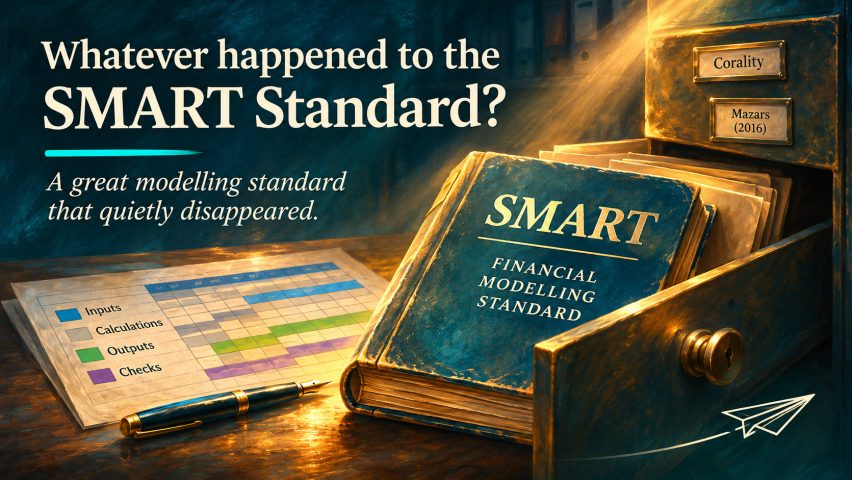
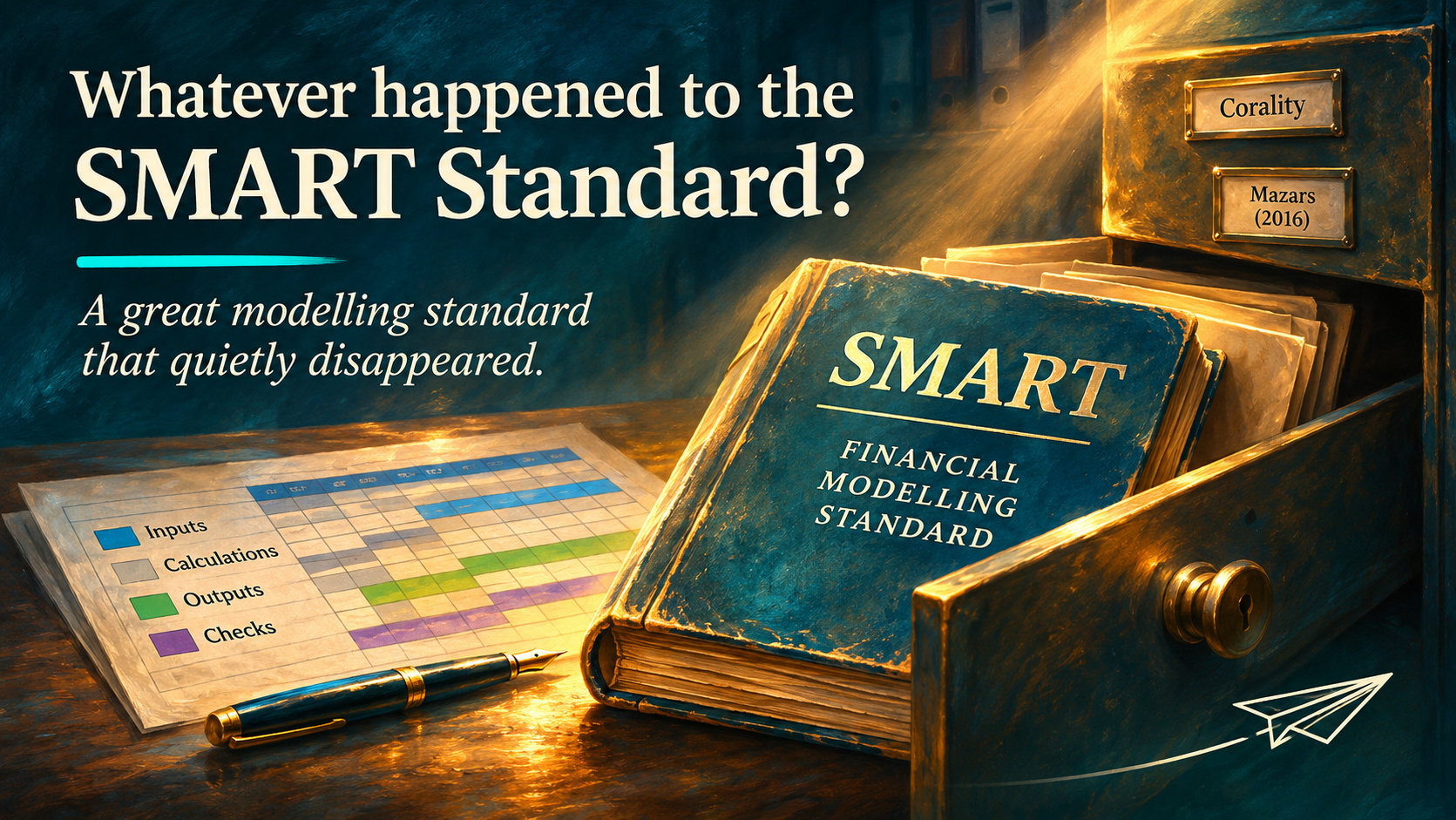
SMART was more than just a colour code. It was a philosophy – one where models were readable, reviewable, teachable, and dare we say, occasionally enjoyable. It gave blue cells to inputs, black to calculations, green to outputs, purple to error checks. A rainbow of discipline. A spreadsheet of sanity.
The training was stellar. Corality became known not just for its modelling chops, but for the way it taught. Practical, digestible, hands-on. If FAST was the Oxford of modelling standards, SMART was the charismatic Australian cousin who’d bought you a coffee, explained cashflow waterfalls, and made you laugh before 10 a.m.
The Acquisition Plot Twist
Then came the twist. In 2016, Mazars, the global audit and advisory giant, acquired Corality.
Now, let’s not make Mazars the villain. They had every reason to buy Corality – project finance expertise, solid clients, and that charming training IP. But here’s the rub:
- Corality’s identity slowly melted into Mazars’ corporate universe
- The SMART Standard was never positioned as an open, independent framework
- No community was built to maintain it beyond Corality
And so it happened. SMART didn’t die. It just… got folded into something else. Absorbed. Diluted. Quietly placed in a folder marked "Internal Templates" somewhere in the depths of SharePoint.
Did SMART Compete With FAST?
This one’s tricky.
- Yes, SMART was a real alternative – elegant, understandable, and user-friendly
- Yes, it was widely taught and implemented in infrastructure, mining, and renewables
- But FAST had the edge in one crucial area: independence
FAST became a standard. It had a documentation structure. An ecosystem. Champions. Events. Even an accreditation body now. It was passed around like gospel, whereas SMART, though brilliant, was tied to its maker. When Corality was no more, SMART’s voice was lost.
So SMART was never defeated. It just never left home.
Where Did SMART Go?
You might still find traces:
- In models built by ex-Corality folks, still structuring sheets with that tell-tale layout
- In training materials on forgotten USB drives labelled "Corality Modelling Bootcamp 2013"
- In consulting firms who once partnered with Corality and still carry the torch in quiet ways
But SMART as a public-facing, living methodology? Gone.
Should We Wish It Back?
Yes. And no. Here’s the thing:
- SMART made modelling human. It made it teachable. You could explain it to interns without using the word "circularity"
- It was prescriptive without being suffocating
- It got people excited about standards, even if they didn’t know what a standard was
But it also had limitations:
- It wasn’t open-source, so it couldn’t outlive its creator
- It wasn’t maintained by the community
- It never built the critical mass needed to thrive without commercial backing
So rather than wish SMART back, maybe we should wish for its best ideas to live on:
- Colour-coded clarity
- Modular layouts
- Teaching as a core modelling skill
And we should fold those into whatever future standards we build – e.g. FAST, or whatever comes next.
It's a Bittersweet Farewell
It’s funny how spreadsheet standards can stir emotion. But SMART did that. It wasn’t perfect. But it was kind. It helped people. It made better modellers. It left its mark.
And perhaps its soft exit is a lesson: the best modelling standards aren’t just about structures and colour codes. They’re about people. About how we train, how we share, how we elevate the work of spreadsheets from the merely correct to the profoundly useful.
So here’s to SMART.
You were bloody good.
You just needed a better succession plan.