
AI & Professional Judgement
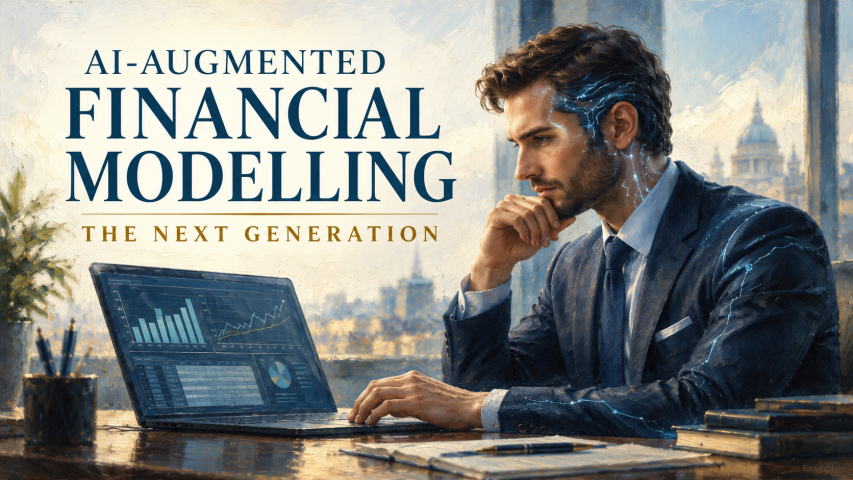
AI-Augmented Financial Modelling: The Next Generation
Originally published 20 March 2026
>For a while now, people have been trying to come up with the perfect name for what humans will become in an AI-shaped future.
The enhanced professional. The AI-native knowledge worker. The prompt engineer. The augmented decision architect. The strategic human-in-the-loop facilitator.
At some point, one begins to suspect that half of modern innovation consists of giving old uncertainty a new badge and a more expensive conference ticket.
But perhaps the answer is simpler than all that.
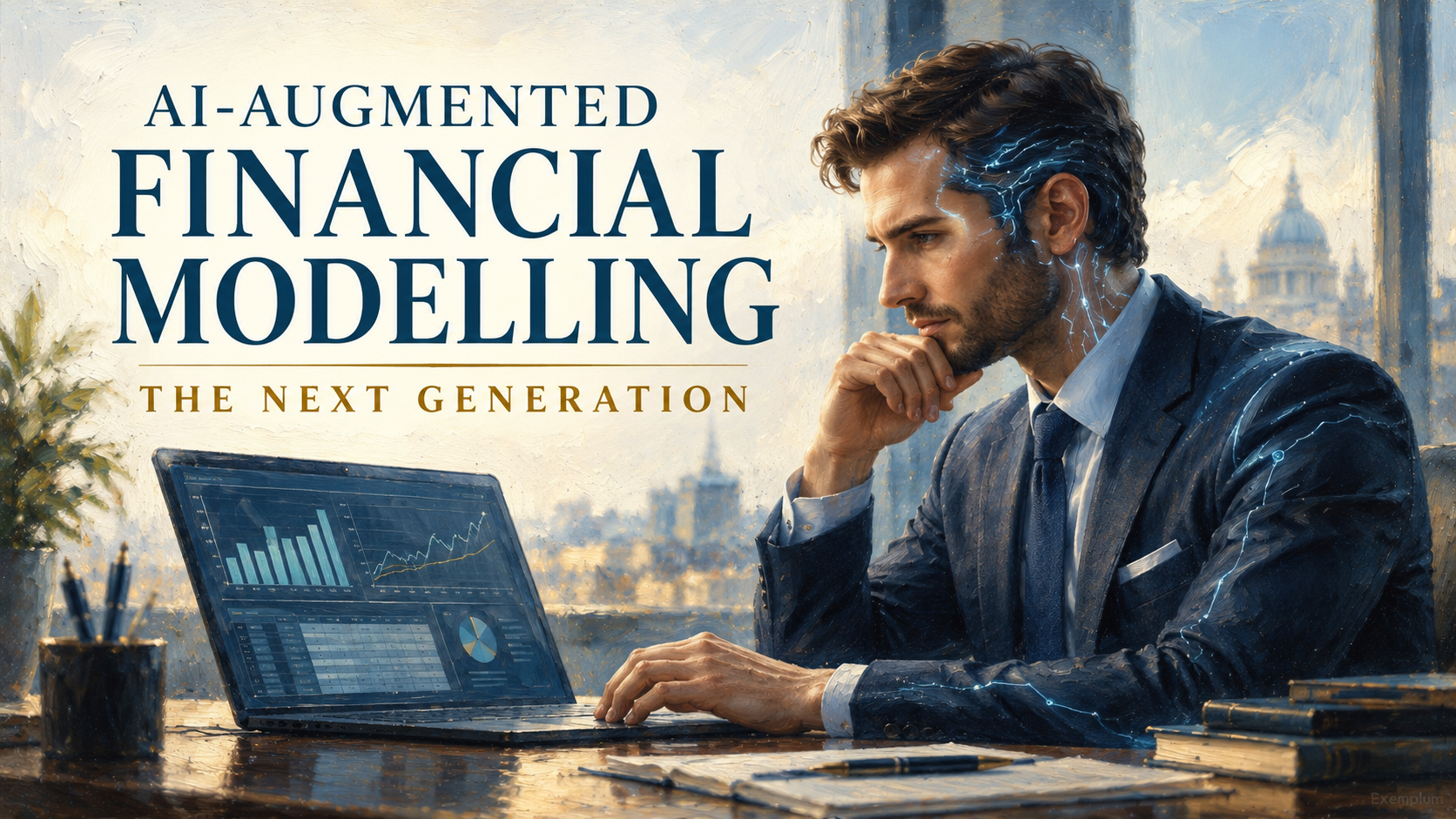
Perhaps we are becoming AI-augmented.
Not replaced. Not obsolete. Not irrelevant. Not magically upgraded into glowing creatures of pure algorithmic enlightenment.
Augmented.
A little like those old science-fiction fantasies. The Six Million Dollar Man. The Bionic Woman. Humans, still very much human, but with added capability bolted on. Better reach. Better speed. Better support. Still responsible for what they do, but no longer relying on muscle alone.
And that, I think, is a far better description of the future of financial modelling than either of the two extreme fairy tales currently doing the rounds.
The first fairy tale says AI will replace the modeller. The second says serious modellers can safely ignore AI because it is all hype and smoke and Silicon Valley theatre.
Both are wrong.
The real future is more awkward, more practical, and much more interesting.
The future financial modeller will still need judgement. Still need discipline. Still need commercial understanding. Still need technical skill. Still need the ability to explain why the model says what it says and whether that answer is sensible, dangerous, incomplete, or in need of a stiff drink and a rewrite.
But that modeller will increasingly work with intelligent assistance.
Research support. Drafting support. Documentation support. Challenge support. Pattern-recognition support. Workflow support. Review support.
In other words, the future modeller may not be replaced by AI.
But they may well be outpaced by someone who knows how to work with it properly.
And there, my friends, is where things become both exciting and a tiny bit dangerous.
The future is not man versus machine. It is man with machine.
One of the most unhelpful habits in the public discussion about AI is this obsession with opposition.
Human versus machine. Craft versus automation. Tradition versus disruption. The noble spreadsheet knight versus the soulless algorithmic beast.
It all sounds very dramatic. It would probably make a fine poster. Perhaps a Netflix series. Dark lighting. Rain. Someone in a tie staring at Excel as if it has betrayed them personally.
But in real life, that is not what is happening.
What is happening is collaboration.
Messy, imperfect, slightly suspicious collaboration, yes. But collaboration nonetheless.
AI is not marching into financial modelling with a tiny briefcase and demanding your desk. It is appearing beside the modeller as a strange new assistant: quick, tireless, occasionally brilliant, frequently overconfident, and in urgent need of adult supervision.
Which, if we are being honest, is not entirely unlike some colleagues we have all met over the years.
The financial modeller of the near future may still spend most of their time doing the things that matter most:
understanding the business structuring the model choosing the right logic defining assumptions testing sensitivities challenging outcomes communicating risks documenting reasoning taking responsibility
But they may now do all of that with significantly more leverage.
That matters.
Because leverage changes the economics of work.
It changes what one individual can produce. It changes what a small firm can compete on. It changes how much quality can be achieved in a limited time. And it changes what clients begin to expect.
That is why this is not just another software update.
This is a professional shift.
What AI may genuinely improve in financial modelling
There is a lot of nonsense in this space, so it is worth saying something unfashionably plain:
Not every use of AI is useful. Not every workflow should be “AI-enabled.” And not every task becomes better simply because a chatbot has been invited to the meeting.
But some things genuinely can improve.
A lot, in fact.
Used properly, AI can help financial modellers with:
Research and contextual preparation Finding background information, summarising concepts, comparing industry practices, preparing questions, checking definitions, and helping frame unfamiliar topics more quickly.
Drafting and documentation Turning rough notes into structured language. Drafting first versions of review findings. Organising report sections. Improving consistency across documentation. Creating client-facing summaries from technical material.
Challenge and second-pass thinking Playing the role of intellectual sparring partner. Testing whether assumptions are coherent. Surfacing possible blind spots. Suggesting alternative explanations, scenarios, or challenge questions.
Knowledge organisation Helping turn scattered internal know-how into checklists, notes, reference material, and reusable guidance. That is particularly useful for firms trying to scale wisdom without scaling chaos.
Workflow acceleration Reducing the time spent on repetitive supporting tasks so more time can be devoted to the work that still requires human judgement.
And that, really, is the sweet spot.
Not replacing judgement. Not outsourcing responsibility. But reducing the amount of human energy wasted on things that should not consume the best part of one’s Thursday.
Because that is the promise of augmentation at its best: not to make professionals unnecessary, but to make them more effective.
Why this is good news, especially for smaller firms
Large firms have always had certain advantages.
More people. More infrastructure. More internal specialists. More process layers. More templates. More branded PowerPoint, which, depending on your mood, may or may not count as a civilisational achievement.
Small specialist firms, on the other hand, often live by focus, quality, speed, trust, and personal credibility. They are sharp, but they are limited by the fact that a human being still only has one brain, two hands, and a finite tolerance for admin.
AI changes that equation.
Not by magically turning a boutique consultancy into a giant machine. But by allowing small teams and independent experts to extend their reach.
A strong modeller with sensible AI support may be able to:
prepare faster document better capture internal knowledge more systematically challenge ideas more broadly serve clients more consistently free time for higher-value thinking
That is not a small thing.
It means the future may favour not just the biggest firms, but the most intelligently organised ones.
And that is rather encouraging.
Because it suggests the next generation of professional services may not belong exclusively to scale.
It may belong to those who combine judgement, standards, and intelligent tooling most effectively.
That is a much more interesting race.
But here comes the awkward part: more power also means more risk
Now then.
This would be a lovely place to become inspirational and post a sunrise image with words like possibility, transformation, and future-ready mindset floating over a mountain.
But unfortunately, reality has once again chosen to be reality.
Because more capability does not automatically produce more wisdom.
It can also produce faster mistakes.
And in financial modelling, fast mistakes are still mistakes. Occasionally very expensive mistakes. Occasionally the sort of mistakes that arrive quietly in Excel and then leave loudly in a boardroom.
The dangers are real.
Plausible nonsense AI can produce convincing language, elegant explanations, and neat-looking reasoning that are simply wrong. Not obviously wrong. Not clownishly wrong. Wrong in the smooth, tailored, dangerous way that makes busy people nod.
False confidence Because AI often sounds certain, users can become less critical precisely when they should become more critical.
Black-box habits There is a risk that modellers begin to accept outputs they can no longer fully explain, trace, or defend. That is not progress. That is professional decay wearing futuristic sunglasses.
Loss of context A model is never just a collection of formulas. It reflects commercial logic, contractual reality, accounting treatments, financing structures, operational assumptions, stakeholder interests, and often a rich history of compromise, scar tissue, and lessons learned. AI can miss that context completely.
Deskilling If professionals rely too heavily on tools to think for them, they may gradually lose the sharpness required to challenge what they are being shown. You do not notice that happening immediately. That is what makes it dangerous.
Confidentiality and governance risks Data handling, client sensitivity, process discipline, and intellectual property do not become less important in an AI-enabled workflow. They become more important.
So yes, the future is exciting.
It is also full of trapdoors.
Which is why the right attitude is neither worship nor rejection.
It is controlled adoption.
Please do not join the new AI priesthood
Another danger, and a deeply modern one, is the rise of the influencer mystics.
You know the type.
They speak in revelations. They have “frameworks.” They tell you everything has changed forever, usually by Friday. They imply that they alone have pierced the veil and discovered the sacred truth of how AI must now be used by all serious professionals.
A week ago they were personal branding experts. Before that, growth strategists. Before that, probably blockchain druids. Now they stand upon a digital hill, wrapped in the soft blue glow of borrowed certainty, announcing that only they can guide you through the new age.
This should be resisted.
Firmly. Politely. With a raised eyebrow.
Because AI is important, yes. But it is not mysticism. It is not sorcery. It is not a priestly secret. It is a set of tools and methods that must be understood, tested, governed, and applied in context.
Anyone who tries to turn that into a personality cult is not helping professionals.
They are selling fog.
A serious professional does not need a guru.
A serious professional needs:
clear use-cases honest limitations good judgement repeatable workflows strong review discipline and the humility to say, “That may be clever, but I still need to verify it.”
That last sentence, by the way, may become one of the most valuable professional habits of the next decade.
Not blind enthusiasm. Not cynical rejection. Verification.
How terribly old-fashioned. How wonderfully necessary.
How to identify real use-cases without losing your mind
One of the reasons many firms get stuck with AI is that they begin at the wrong level.
They ask: “What is our AI strategy?”
Now that sounds grand. It sounds leadership-ish. It sounds like the sort of sentence that belongs on a whiteboard beside the words vision and synergy.
But it is often too abstract to be useful.
A better starting question is this:
Where, exactly, do we have work that is repetitive, time-consuming, reviewable, and worth improving?
That is where real use-cases live.
A sensible AI use-case in financial modelling often has several of the following features:
It is clearly defined If nobody can describe the task properly, AI is not your main problem.
It consumes time but not necessarily final judgement The best early use-cases are often tasks that support decision-making rather than replace it.
Its outputs can be reviewed by a human expert If nobody in the firm can judge whether the output is right, that is not augmentation. That is gambling with better branding.
Errors are detectable A workflow becomes much safer when you know what failure looks like and how it will be caught.
It creates genuine value Either in speed, consistency, coverage, quality, organisation, or client service.
It respects confidentiality and governance No amount of productivity is worth careless handling of sensitive information.
That is the practical lens.
And when you use that lens, the first wave of valuable use-cases tends to be delightfully unglamorous.
Meeting-note processing. First-draft report writing. Checklist creation. Research preparation. Question generation. Structured summarisation. Knowledge-base organisation. First-pass finding categorisation. Workflow documentation.
Not sexy. Very useful.
And that is one of the best ways to stay sane in this whole discussion.
Ignore the fireworks. Look for the plumbing.
The firms that win will not necessarily be the ones shouting loudest about transformation.
They may simply be the ones who quietly identify twenty practical use-cases and implement them well.
How to keep up without becoming ridiculous
A fair number of professionals are currently caught between two unpleasant feelings.
On one hand: “I do not want to be left behind.”
On the other hand: “I do not want to become one of those people posting daily about how I asked a machine to write an email and therefore civilisation has entered a new epoch.”
This is, to be fair, a reasonable tension.
So let us make it simpler.
Keeping up does not require becoming an AI evangelist.
It requires becoming a disciplined experimenter.
That means:
learn the tools test them on low-risk tasks observe where they genuinely help observe where they fail document useful workflows protect confidential data build internal rules preserve accountability keep humans responsible for conclusions
In other words, do not adopt AI as a belief system.
Adopt it as a professional capability.
That distinction matters.
Because one leads to competence. The other leads to insufferable LinkedIn content.
A healthy approach to keeping up might look like this:
Start small. Pick one or two real use-cases. Run controlled experiments. Compare outcomes. Keep what works. Reject what does not. Refine what is promising. Write down the rules. Review the process. Repeat.
There is nothing glamorous about that.
Which is exactly why it is probably the right way to proceed.
Why standards matter even more in an AI-augmented world
There is a peculiar misconception floating about that AI will somehow make standards less important.
As though the more powerful and fluid our tools become, the less we need discipline.
This is nonsense.
If anything, the opposite is true.
The more AI is integrated into financial modelling, the more important standards become.
Because standards are what keep augmentation from decaying into chaos.
We will need stronger expectations around:
transparency traceability reviewability explainability documentation governance responsibility change control quality assurance
If AI assists with drafting, the modeller must still understand and own the content. If AI assists with analysis, the reasoning must still be challengeable. If AI helps accelerate a process, the process must still remain auditable. If AI influences outputs, there must still be a human who can explain why those outputs were accepted.
This is not bureaucracy for its own sake.
This is professional survival.
Because in a world where outputs can be generated faster, the ability to distinguish robust work from seductive nonsense becomes a central professional skill.
That is why standards such as FAST, SMART, the ICAEW code, and the broader next generation of modelling principles remain deeply relevant.
Perhaps even more relevant than before.
AI does not reduce the need for good architecture, good documentation, good logic, and good review.
It punishes their absence more efficiently.
The future role of the financial modeller
So what, then, does the future financial modeller look like?
Not a machine operator. Not a passive recipient of tool output. Not an old-fashioned technician pretending nothing has changed. And not a motivational speaker with a prompt library and too much self-confidence.
The future financial modeller may increasingly become something like this:
a designer of robust model logic a curator of tools and methods a reviewer of machine-assisted outputs a translator between business reality and technical structure a guardian of explainability a steward of standards a decision-support professional with expanded reach
That is a bigger role, not a smaller one.
It asks more of us.
More judgement. More scepticism. More flexibility. More process awareness. More responsibility.
In a strange way, AI may make human quality more visible, not less.
Because once machines can assist with the obvious parts, the real differentiator becomes the quality of human thinking around them.
The framing of the problem. The understanding of context. The sense of materiality. The discipline of challenge. The willingness to say, “This looks neat, but I do not trust it yet.” The maturity to know where tools stop and responsibility begins.
That is not the disappearance of the modeller.
That is the evolution of the modeller.
A final thought from the slightly bionic future
I suspect the future workplace will not be filled with robots marching triumphantly between desks while frightened accountants hide behind printers.
It will be much more ordinary than that.
A modeller will sit down in front of Excel. They will still worry about assumptions. Still untangle circularities. Still argue about revenue ramps and working capital timing and whether the downside case is honest enough. Still explain to somebody, somewhere, that EBITDA is not cash. Because some laws of the universe remain eternal.
But around that work, beside that work, supporting that work, there will increasingly be intelligent assistance.
And the professionals who thrive will not be those who worship it.
Nor those who refuse to touch it.
They will be those who learn how to use it without becoming dependent on it. Those who remain curious without becoming gullible. Those who improve their leverage without weakening their judgement. Those who embrace augmentation without surrendering responsibility.
So yes, perhaps we are becoming something slightly more than what we were.
Not less human. Not replaced. Not obsolete.
Just equipped differently.
A bit augmented. A bit bionic. Still fallible. Still responsible. Still very much on the hook for the consequences.
And perhaps that is the real next generation of financial modelling.
Not artificial intelligence replacing human judgement.
But human judgement, properly supported, becoming more powerful than before.
Which, now that I think about it, is probably the most hopeful version of the future we are likely to get.
And frankly, I will take that.
