
Technology & Perspectives
I Accidentally Became a Linux Person
And somehow became less afraid of computers along the way.
I did not plan to become a Linux person. It just happened… by acccident… by tipping my toe into undiscovered waters… this is how any questionable journeys begin.
I only wanted to have a quick look around.
A few months ago, Linux lived in the same mental category as learning Japanese, restoring a classic car, or becoming one of those people who bake their own bread and know far too much about flour. Interesting. Admirable. Potentially useful. Almost certainly not for me.
But what did I do?
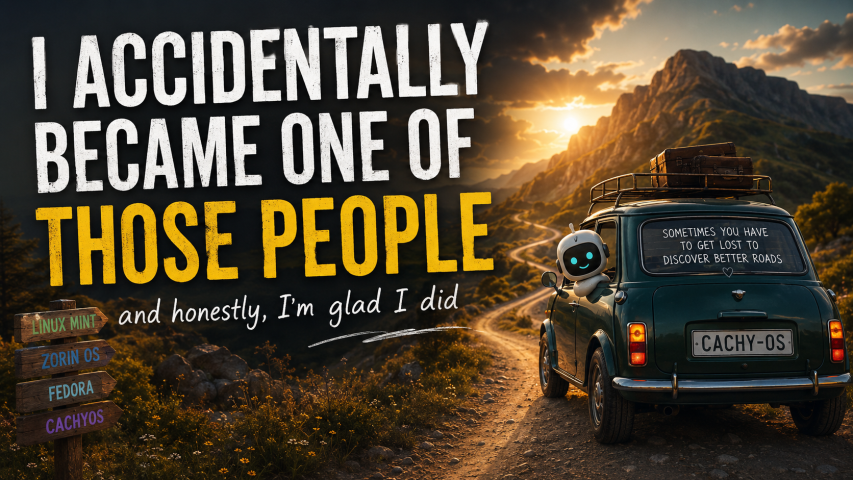
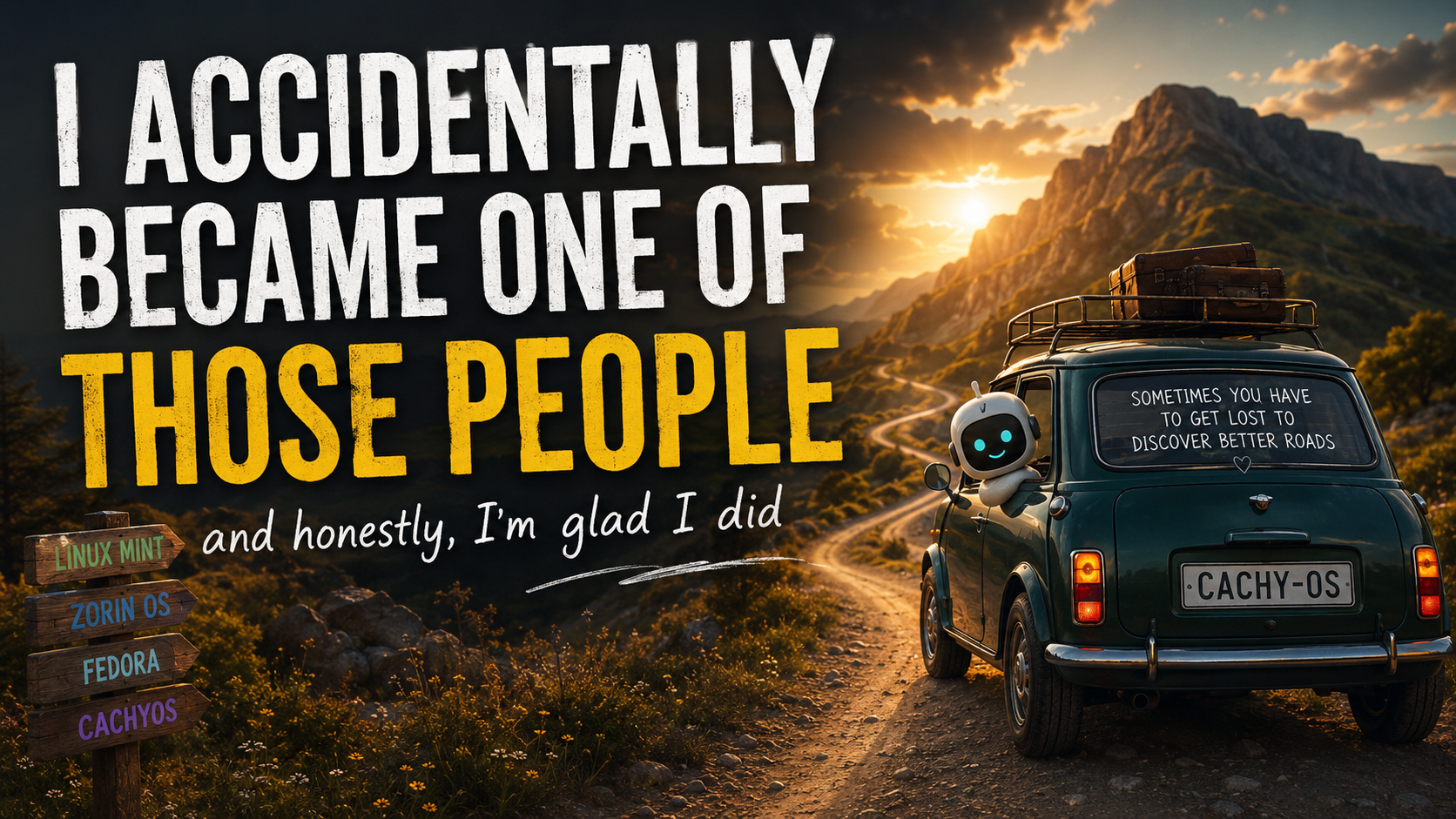
Linux Mint became Zorin OS. Zorin OS became Fedora. Fedora eventually became CachyOS. Somewhere along the way, I found myself discussing bootloaders, package managers, local AI transcription, file systems and desktop widgets with the seriousness of a man who had apparently made some surprising choices in life.
And, I will not lie to you, I am still not entirely sure if I am on the right path here.
What I do know is this: Somewhere during that journey, I stopped being afraid of computers again.
And that, I think, is an exciting point to make
The Things We Never Try
Most of us have a private list of things we assume belong to other people.
Not things we actively dislike. Not things we believe are impossible. Just things that feel slightly too far away from who we think we are.
For me, this list was: Linux. Programming. Photography. Home automation. Video editing. Music production. Building a website. Running local AI. Learning French properly. Running a marathon. The list is different for everyone, but the feeling is usually the same. The reward looks attractive. The learning curve looks expensive.
Not financially expensive. Mentally expensive.
Every new subject appears to carry a hidden tax: hours of searching, reading, filtering, misunderstanding, trying, failing, searching again, and eventually finding an answer written eight years ago for a version of the software that no longer exists, and the worst of all – practice, practice, practice.
For years, Linux looked exactly like that to me.
I use technology all day long. When it works, I barely notice it. When it breaks, I want it fixed, preferably before it has had a chance to ruin my afternoon, evening or weekend. I run a small business. I have customers. I have a family. I do not generally regard a broken computer as a spiritual growth opportunity. I typically breathe in, and then I lose my temper. Technology rage is absolutely comparable to traffic rage, proven by science.
And yet, listening people talking about Linux over the last year or so made me rethink.
I was not listening to Linux enthusiasts. Those have always been talking about Linux. The rest of us have mostly been nodding politely and hoping nobody asks us about partition tables.
No, this was different. Ordinary users were talking about Linux. People who sounded suspiciously normal. People who said things like, “You can switch these days and barely notice.”
Historically, that sentence was often followed by six hours of configuration, three forum posts and a detailed explanation of why suffering builds character. Yet I kept hearing it. Again and again.
Eventually curiosity got the better of me.
Which, in my experience, is usually how I get in trouble.
Things Escalated Quickly
The original plan was modest. Install Linux Mint. Have a look around. Satisfy my curiosity. Return to normal life.
Well… this did not work out.
Mint was the gentle beginning. It showed me that Linux could feel familiar. Zorin OS continued that thought and made the Windows-to-Linux transition feel even less dramatic. Fedora then (recommended to me to make my 4-years-old cutting edge technology thinkpad work with Linux… anyway) felt like a bridge into something more modern and slightly stricter, especially once topics like proprietary codecs entered the conversation.
And then came CachyOS. Everybody currenty recommends CachyOS right now. It’s leading nearly every ranking out there. ished Arch-Linux CachyOS is a blazingly fast, performance-focused Linux distribution built on top of Arch Linux. This is no beginner Linux anymore, safety nets are off there. If you have no idea, what I am writing about here, that’s okay. I was you – exactly two months ago.
CachyOS on my little but powerful EliteMini with KDE Plasma is a really fascinating thing. If Linux Mint felt like entering through the front door, and Zorin OS felt like somebody had kindly placed a welcome mat there for nervous Windows users, CachyOS felt like walking into a Formula One garage when you had only meant to look at bicycles.
It was fast. It was modern. It was beautiful in that slightly dangerous way very capable things can be beautiful. It also came with the unsettling discovery that there was a setting for almost everything, including, I suspect, settings for the settings.
Everywhere I looked, something could be adjusted, moved, resized, replaced, pinned, hidden, unhidden, recoloured or reimagined entirely. Windows often gives you the feeling that the computer has already decided how you should work. KDE Plasma gives you the feeling that the computer is quietly asking, “How would you like this to behave?”
This is liberating.
It is also slightly dangerous for anyone with a curious mind and insufficient supervision.
There were moments when the flexibility felt almost absurd. Not because KDE Plasma allowed me to change a wallpaper or pin an application somewhere. Windows can do that too, and you would be right to roll your eyes if that were the whole point. What felt different was the depth of the negotiation. Panels were not merely taskbars; they were objects I could move, reshape, populate with widgets, strip down or rebuild. The desktop was not just a place for files, but a surface where icons, launchers and small applications could coexist under slightly different rules. Even the recycle bin, as I eventually discovered, was not really an icon in the way I had assumed, but a Plasma widget with its own behaviour. That was the moment I began to understand why KDE users talk about customisation with the calm intensity of people discussing kitchen layouts. It was not always simpler than Windows. But it felt less like adjusting a finished product and more like arranging a workspace. It felt mine in a way Windows rarely feels mine.
That distinction matters more than I expected.
A computer that allows you to change everything can be overwhelming. But it can also quietly change your relationship with the machine. You stop feeling like a tenant. You start feeling like an owner again. Remember the good old times, when this was normal?
The Patient Passenger
The truth is that I did not make this journey alone. There was always a voice beside me. In my case, that voice happened to be Gemini.
Not because I conducted a rigorous scientific comparison of every AI model available. The truth is far less impressive. At some point I had read that ChatGPT was particularly strong at writing and reasoning, Claude excelled at structuring and building things, and Gemini seemed well suited to research and technical questions. Whether that assessment is completely fair, I honestly do not know. What I do know is that Gemini somehow became my default place for asking technical questions, and before long it became part of my Linux adventure.
The specific model is not really the point. For someone else, it might be ChatGPT, Claude or whatever comes next. The important thing was not the logo on the tool. The important thing was that, for the first time, I did not feel as if I was travelling alone.
That changed everything.
Experts – and I am especially referring to Linux experts here – often forget how much context they carry around in their heads. My last post – classifying Linux distributions into beginner-friendly, intermediate and hard-mode – completely exploded. Most comments came from experienced users, correcting me for calling their favorite distribution “hard-mode”. I see exactly the same thing in financial modelling. After twenty years, concepts that once felt difficult become second nature. You stop noticing how much hidden knowledge sits beneath apparently simple explanations. A beginner asks a question. An expert answers it. The answer contains seven new terms the beginner has never encountered before. One question quietly becomes eight.
Linux is no different.
A beginner asks how to install something. The answer mentions repositories, package managers, dependencies, flatpaks, AUR helpers, system packages and perhaps a small philosophical disagreement about the proper way to manage software. Each of these words may be perfectly reasonable. Together, they can feel like being given a map where every destination leads to another map.
The difference was that I suddely could ask why – without looking into silently judging eyes.
Then ask why again.
Then ask a third time.
And the conversation simply continued.
Sometimes the answers were wrong. Sometimes they were outdated. Occasionally the suggested solution solved a completely different problem than the one I actually had. Which, to be fair, also describes a surprising number of conversations with human technical support.
The important thing was that the conversation never stopped.
That turns out to be remarkably powerful when you are learning something new.
Wrong Turns, Better Roads
One of my favourite examples involved what became known as the Great KVM Switch Mystery.
My EliteMini running CachyOS refused to display an image through an expensive 8K KVM switch. Directly through HDMI, everything worked perfectly. Through the switch, nothing. Naturally, we assumed the problem was complicated. Kernel graphics parameters were discussed. Display detection mechanisms were investigated. There were conversations involving terms such as EDID that I had never expected to encounter in my personal life.
For a while, it looked as though we might end up editing kernel parameters, which still sounds like the sort of activity where an adult should be present.
The actual solution was that the KVM switch needed additional USB power; do not plug it into the PC, plug it directly to power supply.
That was it.
No graphics bug. No Linux problem. No conflict between operating systems. The small box simply wanted more electricity.
Technology has a remarkable ability to begin with advanced diagnostics and end with plugging something in properly.
This happened more than once. I had entered the journey assuming that, whenever something went wrong, Linux would probably be the culprit. That assumption turned out to be surprisingly unreliable. Quite often the problem was old Windows behaviour, leftover boot entries, strange hardware expectations, hidden assumptions from previous installations, or simply my own enthusiastic misunderstanding of what I had just done. In fairness, “my own enthusiastic misunderstanding” is probably a major category in most technical support departments.
Then there was the evening I managed to create what I can only describe as ghost mounts while trying to connect OneDrive and SharePoint through rclone. Through a combination of enthusiasm and imperfect syntax, I launched the command incorrectly and somehow convinced the operating system that a directory was mounted when it very clearly was not. At least not in any way that appeared useful to a human being.
The error message was wonderfully dramatic.
“CRITICAL: Fatal error: directory already mounted.”
I tried the obvious things. Then the less obvious things. Then the things people try when they have run out of obvious things. Nothing worked. The folder appeared to exist in a strange limbo between reality and the kernel, like a spreadsheet link to a file nobody can find anymore.
Eventually we discovered that CachyOS uses FUSE3, meaning the correct command was not but .
One number.
One character.
An entire evening.
The funny thing is that I still remember that lesson because somebody explained why the solution worked. It was not simply a command to copy and paste. It was a piece of understanding.
The same thing happened repeatedly.
At one point I became irrationally annoyed because new desktop files insisted on appearing over the recycle bin. After a surprisingly long investigation involving screenshots and desktop settings, I discovered that the recycle bin was not actually an icon at all. It was a KDE Plasma widget. A small desktop application living happily outside the normal grid system.
I remember staring at the explanation and thinking that this sounded completely ridiculous.
Then, about thirty seconds later, it made perfect sense.
That happened quite often. Linux was not always intuitive, but it was frequently logical once somebody explained the rules of the particular universe I had wandered into.
The same applied to software.
Coming from Windows, I was used to downloading installers, double-clicking files and hoping the correct thing happened. Moving between Linux distributions introduced a completely different way of thinking. Linux software may often be available across systems in principle, but the route to it depends on repositories, package formats, dependencies and the particular dialect spoken by the distribution you are using.
Fedora had its world. Arch had another. CachyOS, being Arch-based, introduced me to the AUR, the Arch User Repository. I had expected , because at that point I had read just enough to be confidently incomplete. CachyOS, however, came with , a fast and modern AUR helper. This is the kind of sentence that would have meant absolutely nothing to me a few months ago and now somehow feels perfectly normal. I am not sure whether that is progress or a warning sign.
One of the small joys was rediscovering WhatSie, a lightweight WhatsApp client I had missed from my Fedora experiments. There was no official Arch version from the developer, but the AUR made it available through community build instructions. From a Windows perspective, this feels almost magical. From a Linux perspective, it is apparently Tuesday.
And then there was Discover.
I went looking for the familiar KDE app store and found instead the minimalist CachyOS Package Installer (like the Microsoft or Google Play Store). So, naturally, I installed Discover manually. This seemed reasonable. Discover appeared. Then a large warning from the CachyOS developers appeared as well, explaining, in effect, that deep system updates through graphical package tools in the Arch world are not always a splendid idea.
That was an important moment because it revealed a philosophy rather than a feature. CachyOS was not trying to be difficult. It was trying to be lean, controlled and safe in a very specific Arch-like way. The solution was not to force Discover to become something it should not be. The solution was to make it a safe Flatpak store for isolated applications, while system packages and updates remained where CachyOS clearly wanted them: in the terminal, through .
A few months earlier I would have found this intimidating. Now I found it oddly satisfying. I was no longer merely installing software. I was beginning to understand why different layers of the system existed and why some tools belonged in one layer rather than another.
The Moment I Stopped Typing
The moment that truly changed my perspective arrived during the CachyOS installation.
By this point, previous experiments with Linux Mint and Fedora had left various traces behind, particularly around the boot process. This eventually introduced me to the fascinating world of bootloaders, which I am still not entirely convinced are a technical component rather than a personality test.
What followed was a familiar troubleshooting cycle. Run a command. Read the output. Try to understand the output. Summarise the output. Send the summary. Receive advice. Repeat.
After a while I realised I was doing something absurd.
I was holding a smartphone. The computer screen was directly in front of me. Why was I acting as a translator between two machines?
So I took a photograph.
That was it. No breakthrough worthy of a documentary. No dramatic technological revelation. Just a photograph of the screen.
Yet the effect was immediate.
Suddenly the AI could see the entire terminal output. Not my interpretation of it. Not the section I thought was important. The whole thing. Error messages. Warnings. Directory structures. The occasional clue I had completely overlooked.
The quality of the conversation changed overnight. The suggestions became more precise. The follow-up questions became more relevant. Most importantly, we were no longer discussing what I thought was happening. We were discussing what was actually happening.
Anyone who has ever tried explaining a technical problem to another person knows how much information gets lost along the way. Half of troubleshooting is often spent establishing a shared understanding of the problem. The photograph solved that instantly.
Once I realised this, I started doing it constantly. Screenshots. Configuration screens. Terminal output. Boot menus. Whatever seemed useful.
The process felt strangely natural. Less like searching for answers and more like collaborating with somebody who happened to have infinite patience.
Thinking back, I am not actually sure Linux became easier.
That may sound like a strange conclusion after months of experimenting with Linux, but I genuinely believe it. Linux is still Linux. Bootloaders remain bootloaders. Package managers remain package managers. Arch Linux remains gloriously unapologetic about being Arch Linux.
What changed was the experience of getting stuck.
That matters more than most people realise.
Maybe This Was Never Really About Linux
For decades, technical learning followed a familiar pattern. Something broke. You searched for an answer. The answer assumed knowledge you did not possess. You searched again. The next answer contradicted the previous one. The third answer was written eight years ago. The fourth linked to a website that no longer existed.
Eventually, curiosity lost the battle.
What struck me most about this entire journey was that curiosity kept winning.
Not because everything worked. Quite a lot of things did not. What changed was that every dead end seemed to contain another path forward. Sometimes it was the correct path. Sometimes it was not. But there was always another idea to test, another explanation to explore, another possibility worth considering.
Somewhere along the way I realised I was no longer trying to learn Linux.
I was enjoying learning Linux.
Those are not quite the same thing.
And that observation extends far beyond operating systems.
During the same period I found myself experimenting with local AI transcription. I discovered that OpenAI’s Whisper could run entirely on my own machine. No cloud service. No subscription. No data leaving my computer. Speech Note became useful for transcribing finished audio files. Whis became useful for live dictation directly at the cursor. Somewhere between fixing bootloaders, rearranging desktop widgets and learning package managers, I had accidentally reached a point where one of the world’s most impressive speech recognition systems was running locally on a small computer on my desk.
A few years ago, that would have sounded like science fiction.
Now it was just another evening.
That may be the most interesting part of the entire story. I started this journey because I wanted to understand Linux. What I discovered was something much broader.
Technical curiosity is becoming rewarding again.
For a very long time, curiosity carried a hidden tax. Every new subject demanded hours of searching, reading, filtering and frustration before meaningful progress could occur. Many people quietly concluded that certain topics simply were not worth the effort. Not because they were lazy. Not because they lacked intelligence. Because the emotional cost of being a beginner was too high.
I am no longer convinced that has to be true.
Not because difficult subjects became easy. Not because expertise became unnecessary. Not because AI magically knows everything. It does not.
But because the distance between confusion and understanding has become shorter than it has ever been before.
That changes behaviour.
If experimenting means you might break something and then spend three days trying to understand what happened, you stop experimenting. If experimenting means you might break something, ask questions, show the problem, understand the next step and recover, you begin to behave differently. You become braver. Not reckless, hopefully. Just braver.
You take the side road. You try the next distribution. You install the unfamiliar tool. You ask the basic question. You photograph the error message instead of pretending you understood it.
You keep moving.
What Is Your Linux?
I sometimes wonder how many people quietly carry around their own version of Linux.
Not the operating system, necessarily, but the thing they assume is probably too difficult for them.
Learning Python. Building a website. Understanding Excel properly. Buying a 3D printer. Recording music. Running local AI. Starting a business. Or learning French.
Maybe the technology is not always the barrier anymore.
Maybe the barrier is an outdated memory of what learning used to feel like.
I still make mistakes. I still break things. I still occasionally stare at a terminal window wondering whether I have solved a problem or accidentally created three exciting new ones. In fairness, this may simply be part of the Linux onboarding process.
But the difference is that I am no longer afraid of finding out.
And honestly, that might be one of the most exciting things technology has given us in a very long time.
Sometimes you have to get lost to discover better roads.
